
Running shoe midsole foam is the primary deformable material between the foot and outsole. EVA, TPU, PEBA, TPEE, and olefin-based foams are polymer families—not guarantees of softness, rebound, stability, durability, or speed.
Formulation, expansion, density, geometry, stack, plates, outsole, temperature, and the runner determine the finished ride.
Over 12 years of running and evaluating shoes, I have learned to use the foam name to form questions. I never use it to finish a review.
Running-shoe foam families at a glance
| Foam family | Common strengths | Common tradeoffs | What the name cannot tell me |
|---|---|---|---|
| EVA | Light, tunable, widely manufacturable | Can firm in cold or lose original feel, depending on formula | Softness, resilience, service life |
| Expanded TPU | Durable-feeling rebound and temperature consistency in many builds | Often heavier than the lightest foams | Finished weight or ride speed |
| PEBA | Strong resilience-to-weight potential | Can be costly, delicate, or unstable in some geometries | That every shoe is soft or fast |
| TPEE | Resilient and tunable performance potential | Behavior varies widely by processing | Exact response or durability |
| Olefin-based foam | Low-density and resilient potential | Brand formulations differ | Whether it beats another family |
| Blends | Can balance weight, softness, stability, and cost | Chemistry is often proprietary | Which ingredient controls the ride |
No family owns one training role. I have run in excellent EVA trainers and poorly matched premium-foam shoes.
What the midsole actually does
The midsole deforms under load, helps distribute pressure, controls how the platform moves, and recovers partly after compression.
Its job includes vertical and lateral behavior. A foam can feel soft downward while sidewalls and a broad base keep the foot centered.
The midsole also gives structure to the rocker, surrounds plates or rods, and connects the upper with the outsole.
That is why I never discuss foam without running-shoe anatomy. The material is one layer inside a connected chassis.
Four terms that foam marketing blurs
Softness
Softness describes resistance to deformation under a particular load or test. It does not reveal total cushioning travel.
Cushioning
Cushioning is the complete load-management experience. It includes thickness, geometry, pressure distribution, stability, and runner perception.
Resilience or energy return
Resilience describes how much mechanical energy is recovered after deformation under a defined protocol. It does not mean free propulsion.
Running economy
Running economy is the runner’s metabolic demand at a given speed. It emerges from the complete shoe-runner interaction.
My guides to cushioning softness and energy return keep those measurements from becoming one vague “superfoam” claim.
EVA: a family, not an old-foam verdict
EVA means ethylene-vinyl acetate. Running-shoe manufacturers have used it for decades because it is light, tunable, moldable, and practical at scale.
The stereotype says EVA is firm, flat, and outdated. Modern EVA makes that shortcut unreliable.
Vinyl-acetate content, additives, crosslinking, blowing method, cell structure, density, and geometry can change the result substantially. Compression-molded EVA and a supercritically expanded EVA formulation may share a family name while feeling unrelated.
EVA works well when designers want predictable compression, structure, and low mass. Some versions change more in cold weather or lose their original sensation with use.
I judge the specific implementation, not the acronym.
TPU: resilient character with a mass question
TPU means thermoplastic polyurethane. Expanded TPU midsoles are often made from fused beads and are known for a durable, elastic sensation in many applications.
The common tradeoff is weight. A full-length TPU build can be heavier than the lightest racing foams, though formulation, thickness, and hybrid construction change that answer.
TPU can make sense in daily trainers where consistent ride and long use matter. A thin layer can also add character inside a mixed-foam shoe.
I do not assume TPU is always durable or weatherproof. Outsole, upper, bonding, geometry, storage, and runner use still determine useful life.
PEBA: excellent potential, not automatic superiority
PEBA means polyether block amide. It became central to modern racing shoes because some formulations combine low density, high resilience, and substantial cushioning depth.
“Some formulations” is the important phrase.
PEBA grades, processing, expansion, additives, density, and geometry vary. One PEBA shoe may feel soft and unstable. Another may feel firm and controlled. A third may place PEBA inside a denser carrier.
Low-density foam can reduce mass, but the shoe still needs adequate platform width, upper hold, and outsole protection.
I buy the system only after it performs at target pace. How running shoes affect running economy explains why the polymer alone cannot promise a metabolic result.
TPEE, olefin foams, and proprietary blends
TPEE is a thermoplastic polyester elastomer used in some responsive midsoles. Olefin-based materials and proprietary blends have expanded the range further.
Brand names frequently hide chemistry or combine materials. The same named foam may change formulation between versions. Two companies may give unrelated names to chemically similar platforms.
A dual-density shoe may use a premium core inside a stable carrier. A top layer may create step-in softness while the lower layer controls compression.
I record disclosed chemistry but describe what I can verify: mass, fit, softness, transition, stability, temperature response, and wear.
What “supercritical foam” means
Supercritical foaming describes a manufacturing process that uses a gas under controlled pressure and temperature to create or expand cells in the material.
It is not one polymer. EVA, TPU, TPEE, and other families can be processed in different ways.
The process may help reduce density or tune cell structure. The final result still depends on formulation, molding, geometry, and quality control.
“Nitrogen-infused” or “supercritical” tells me something about processing. It does not tell me exact energy return, durability, or how the shoe will feel.
Density and hardness are not the same
Density is mass per unit volume. Hardness is resistance to local indentation under a test.
A low-density foam can be formulated to feel firmer than expected. A denser material may feel soft underfoot when geometry allows deep compression.
Cell size, cell walls, skin, additives, and surrounding structures affect both behavior and durability.
I avoid calling a shoe lightweight because the foam looks porous. I weigh the complete shoe and state the sample size.
Geometry can overpower chemistry
Foam behavior changes when designers alter:
- Heel and forefoot stack
- Platform width
- Sidewall height
- Heel bevel
- Forefoot rocker
- Cutouts and cavities
- Segmentation
- Medial and lateral flare
- Plate location
- Outsole coverage
A broad sidewall can contain soft foam. A deep cavity can make firm material deform more. A rocker can make dense foam transition smoothly without becoming softer.
My modern stability shoe guide shows how geometry controls compliant foam.
Stack changes the amount of usable foam
More stack provides more material depth and design freedom. It can increase cushioning travel while raising the foot farther from the ground.
Height does not reveal hardness. A tall shoe can be firm. A thin shoe can be soft and bottom out.
Platform width and sidewalls determine whether the runner can control that foam volume.
I read running-shoe stack height alongside chemistry before making any protection or stability claim.
Plates and foam form one structure
A plate changes how the sole bends and how load spreads through the midsole. The foam supports the plate, while the plate can control foam deformation.
Soft vertical compliance can therefore coexist with strong heel-to-toe stiffness.
Plate depth, shape, thickness, material, and surrounding foam determine the result. A stiff element too close to the foot may create pressure. The same element deeper in thick foam may feel smoother.
Running-shoe plates explained covers that interaction without crediting the plate or foam alone.
Outsole rubber changes the ride
Rubber protects exposed foam and creates grip. It also adds mass and stiffness.
Full coverage can constrain midsole deformation and make a platform feel more continuous. Strategic patches save weight and allow selected flex zones.
When a new version keeps the foam name but changes outsole coverage, I expect the ride to change.
The outsole can also determine which parts of soft foam contact the ground directly and abrade.
My running-shoe outsole rubber guide explains why foam durability cannot be judged without the contact layer.
Carrier, core, and dual-density constructions
A foam name on the product page may describe only the visible layer or premium core. The foot can be loading two or three materials during the same step.
A firmer carrier may wrap a softer core to control lateral deformation. A softer top layer can improve immediate comfort while a denser lower layer resists bottoming. Medial and lateral zones may also use different shapes or formulations.
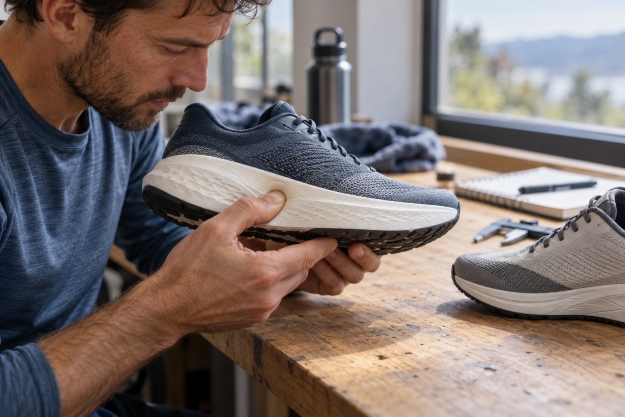
I press and inspect the sidewall to locate transitions, but field behavior matters more. A poorly placed boundary can feel like an arch ledge. A well-integrated construction feels continuous even when the materials differ.
When comparing versions, I check whether the named foam changed, whether its volume changed, and whether the carrier geometry changed. Keeping one branded material does not mean the midsole system stayed the same.
How laboratories test foam
Durometer testing estimates hardness at a location. Compression tests record deformation under a defined load. Mechanical cycling can track force response, thickness change, or energy loss.
Every result depends on specimen preparation, thickness, temperature, rate, load, location, conditioning, and cycle count.
A cut foam puck answers a material question. An intact shoe answers a system question. Neither automatically predicts comfort or running economy.
Running-shoe lab tests explained provides the metadata checklist I require before comparing precise values.
Temperature changes need controlled comparison
Polymers respond to temperature differently. Some midsoles feel much firmer after cold storage. Others remain relatively consistent.
The shoe can warm during running, and the runner starts differently in cold weather. That makes a single winter impression difficult to isolate.
I keep comparison pairs in similar storage, note air temperature, and record first-mile and working behavior separately.
My field procedure is in how temperature affects running-shoe foam.
How midsole foam ages
Repeated loading can change cell structure, compression, recovery, and shape. The direction is not always a simple move from soft to hard.
A shoe may soften, flatten, lose resilience, lean, or feel harsher because usable travel decreased. Outsole wear and upper stretch occur at the same time.
Storage heat, direct sun, moisture, and poor handling may also affect foam or bonding.
There is no universal retirement mileage by polymer family. I track whether the shoe still performs its assigned job.
My running-shoe lifespan guide shows how I combine foam behavior with outsole grip, upper hold, platform symmetry, and the shoe’s original role.
Ken’s six-stage foam test
1. Establish fit and platform coverage
My moderately wide forefoot must sit over usable foam. A premium material cannot rescue spillover or heel slip.
I establish that baseline with my loaded guide to how running shoes should fit before attributing any sensation to the foam.
2. Run below the sweet spot
I start easy. I note heel settling, forefoot depth, transition, and whether the foam feels compliant or uncontrolled.
3. Run at intended pace
I want compression and recovery to match the job. A race foam should become coordinated, not merely louder.
4. Add turns and braking
I test both directions and a safe mild downhill. This separates vertical softness from lateral control and forefoot depth.
5. Extend into fatigue
I monitor bottoming out, medial or lateral drift, slower transition, and any need to grip with my toes.
6. Compare conditions and recovery
I record temperature, route, wear state, and next-morning response. I repeat unexpected findings before treating them as a material property.
At 182 pounds, late-run behavior matters more to me than a short store bounce.
Choosing foam by role
| Role | Behavior I want | Failure that ends the role |
|---|---|---|
| Recovery | Calm compression at slow cadence | Wobble or excessive sinking |
| Daily trainer | Predictability across pace and weather | Early ride change or unstable fatigue |
| Long run | Preserved forefoot depth and smooth transition | Bottoming out or one-sided collapse |
| Tempo | Quick recovery with controlled turns | Mushy transition or localized pressure |
| Race | Low mass and coherent target-pace response | Instability, poor fit, fragile grip |
| Trail | Controlled deformation and surface adaptation | Excessive edge collapse |
No polymer owns a row. Construction and fit decide.
Buying mistakes I avoid
This is the checklist I use when a product page makes one material sound like the whole shoe. Each mistake begins with a true fragment—PEBA can be light, soft foam can feel comfortable, resilient materials can help—but stretches that fragment into a buying conclusion the evidence cannot support.
I correct the mistake by returning to the shoe’s assigned job. If the foam story does not tell me how the complete platform behaves at my pace, under my load, and late in the run, it has not earned the purchase.
Buying the acronym
PEBA, TPU, or a branded foam name is the start of the investigation, not the conclusion.
Before I pay a premium, I identify how much of that material is actually present and what surrounds it. A thin premium insert inside a dense carrier is a different proposition from a full-length low-density midsole, even when both boxes display the same acronym.
I then compare finished weight, platform width, rocker, outsole coverage, and intended pace. If those details do not suit the job, the chemistry cannot rescue the shoe.
Calling softness protection
Softness changes sensation and loading. It does not guarantee injury prevention.
A plush step-in feel can come from a soft top layer while the lower platform remains firm. Deep compression can also feel protective at first but become unstable, bottom out, or demand more control as I fatigue.
I judge protection by what happens after the easy opening miles: whether sharp contact stays muted, forefoot depth remains available, and my gait stays natural. I never use softness as permission to increase training load faster.
Assuming high energy return means faster
Mechanical resilience can contribute. Runner-level economy and race performance require the complete system.
A highly resilient foam can still sit inside a shoe that is too heavy, poorly fitted, unstable, or awkward at my target pace. It can also return energy in a direction or timing that does not cooperate with my stride.
My test is practical: I compare equal-effort running, pace control, turns, and late-run coordination against a known shoe. If the new pair feels dramatic but makes the session less repeatable, I do not call it faster.
Ignoring temperature
A warm store and a cold winter route can produce different behavior.
I avoid making a seasonal purchase from one indoor try-on. Storage temperature and outdoor exposure can alter initial hardness, transition, and grip before the shoe warms through movement.
For a winter trainer, I want acceptable behavior from the first mile—not only after twenty minutes. I record the temperature and compare like with like rather than blaming every cold-day change on the foam alone.
Ignoring size and body mass
Material volume and loading differ. The sample review may not reproduce my men’s US 10.5 experience.
Larger sizes can contain more material and weigh more, while different runners compress the same platform to different depths. A light runner may describe a shoe as firm where I find usable travel; a heavier runner may reach the bottom of a platform that feels controlled to me.
I use another reviewer’s experience to form a question, then answer it under my own load. My deciding observations are forefoot depth, lateral control, transition, and how those change with duration.
Projecting new-shoe feel forever
Foam, outsole, upper, and bonding change with use.
Some shoes settle into a better rhythm after the first few runs. Others lose the exact snap or support that justified the purchase. Cosmetic creasing alone tells me very little, so I log function rather than photographing wrinkles.
I repeat the same route and pace checkpoints as mileage accumulates. When transition slows, the platform leans, forefoot depth disappears, or control becomes inconsistent, I reassess the shoe’s role—even if the foam still looks clean.
My foam decision rule
I never buy a foam family in isolation. I define the shoe’s job, name the behavior I need, and then test whether the complete platform delivers it without an unacceptable tradeoff.
For a daily trainer, I value predictability across easy pace, weather, turns, and fatigue. For a race shoe, I may accept a narrower pace window if the foam-geometry system becomes coherent at target pace. My race shoe versus daily trainer guide shows why the same material can pass one role and fail the other.
The final question is not “Is PEBA better than EVA?” It is “Does this implementation keep the behavior I need for the miles, pace, temperature, and surface I will actually run?”
Frequently asked questions
Is PEBA always better than EVA?
No. PEBA often has strong resilience-to-weight potential, but geometry, fit, durability need, stability, and pace determine the better shoe.
Is TPU more durable than PEBA?
Some TPU constructions maintain their character well, but family name cannot guarantee useful life. Formulation and full-shoe design matter.
What is the softest running-shoe foam?
Polymer family alone cannot answer. Density, formulation, expansion, thickness, geometry, temperature, and test method determine softness.
What is a superfoam?
It is an informal label for lightweight, resilient modern midsole materials. There is no single chemistry or regulated performance threshold.
Does nitrogen-infused foam contain air pockets?
Gas-assisted processing can create a cellular structure. The marketing phrase does not reveal cell design, density, or finished ride.
Does more foam mean more cushioning?
More stack provides more material depth, but hardness, geometry, platform, and runner load determine usable cushioning.
Can midsole foam prevent injuries?
No foam offers that guarantee. Footwear changes load and comfort while training, previous injury, recovery, terrain, and capacity remain important.
How do I know when foam is dead?
Look for repeatable functional change: lost depth, slower transition, uneven lean, harsher contact, or reduced control—not cosmetic creasing alone.
My bottom line
The foam acronym tells me which material family may be inside the shoe. It does not tell me the finished ride.
I evaluate formulation clues, density, stack, geometry, plate, outsole, temperature, pace, wear, and how my foot sits on the platform.
The best midsole is not the newest chemistry. It is the one that keeps its intended behavior through the miles I actually run.

Written by Ken — the recreational distance runner behind NextGait. My foam guides combine 12 years of running decisions with pace-specific field checks, controlled comparisons, and careful limits on what a polymer name or laboratory value can prove. More about me →