
Quick answer: A practical half marathon nutrition plan starts 24-48 hours before the race with familiar carbohydrate-rich meals. Eat a tested, low-fiber breakfast 2-4 hours before the start. For runners finishing in about 75 minutes to 2.5 hours, 30-60 grams of carbohydrate per hour is the standard evidence-based range. Start fueling around 20-30 minutes instead of waiting to fade. Drink to a practiced plan based on thirst, sweat rate, weather, and aid-station access, and never drink enough to gain weight.
Half-marathon nutrition is a logistics problem wearing a health-food costume. The hard part is rarely knowing that a bagel contains carbs. It is deciding how much breakfast you can digest at 5:00 a.m., whether the on-course drink agrees with you, where the next water table sits, and how to open a sticky packet when your hands are cold.
On long runs, I care less about having the trendiest gel than having a plan I can execute without thinking. The packet opens cleanly. I know whether it needs water. I have counted the carbohydrate in my drink. I have used the same breakfast at training pace and at goal effort. That quiet rehearsal is what makes race morning feel familiar.
This guide is for U.S. runners preparing for 13.1 miles, from fast racers who may take little fuel to first-timers running beyond two hours. Pair it with a complete half marathon training plan and the broader runner’s nutrition guide. Nutrition supports training; it does not replace pacing, mileage, sleep, or recovery.
Half Marathon Nutrition Plan by Finish Time
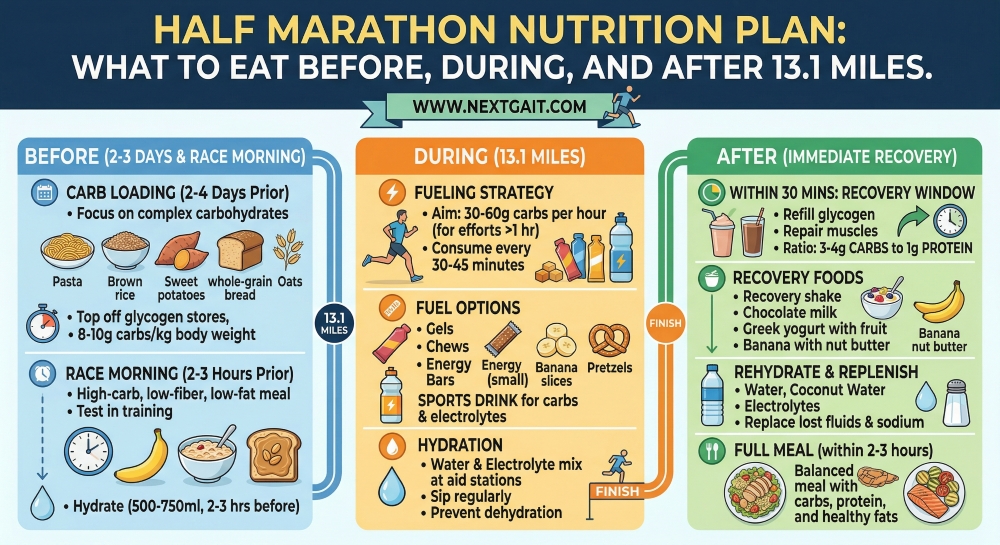
Your expected finish time is more useful than distance alone. The World Athletics nutrition consensus lists a small carbohydrate amount or mouth rinse for shorter events and 30-60 g/hour for efforts lasting 1-2.5 hours. Longer runners may still use that range, building only after their gut has adapted.
| Expected finish | During-race starting point | What matters most |
|---|---|---|
| Under 75 minutes | Optional small carb amount or mouth rinse | A strong pre-race meal; avoid slowing for unnecessary intake |
| 75-100 minutes | About 30 g/hour | One or two practiced servings; start before halfway |
| 100-150 minutes | 30-60 g/hour | Count gels, chews, and sports drink in one total |
| 150-180 minutes | 45-60 g/hour if trained | Earlier intake, steady delivery, careful fluid planning |
| Over 3 hours | Usually 45-60 g/hour; higher only after gut training | Comfort, aid-station logistics, heat, and avoiding overdrinking |
Do not convert the table directly into a gel count. One gel may contain 20 g, another 30 g. A cup of sports drink might add 10-20 g depending on concentration and serving size. Read labels and check the race website. The unit that matters is grams of carbohydrate per hour, not packets per race.
Ken’s Three-Check Rule
Ken’s Three-Check Rule: Every race-day item must pass three checks: stomach, math, and logistics. Stomach means you tolerated it during long runs and at goal effort. Math means every gel, chew, and ounce of sports drink is counted in the same carbohydrate total. Logistics means you can carry it, open it, and pair it with the right fluid at the actual aid stations.
Most bad plans fail one check. A runner tests a gel on an easy jog but never at race effort. Another plans three gels and forgets that every aid station offers carbohydrate drink. A third rehearses perfectly, then discovers the course has water at miles 2, 5, 8, and 11 while the gel plan assumes water every mile.
Write the race plan on one line: breakfast time and food, optional pre-start top-off, each fuel time, the fluid paired with it, and a backup. If that line requires a spreadsheet during the race, simplify it.
Build the Plan During Training, Not Race Week
Race nutrition starts four to eight weeks out. Use selected long runs to rehearse the breakfast, carb rate, fluid source, clothing storage, and effort. You do not need full race fueling on every run, but you need enough repetitions to separate a one-off good day from a plan your gut recognizes.
The rest of the week still matters. Chronic underfueling can flatten workouts, slow recovery, and raise health concerns even when race-day gels are perfect. Match normal meals to the workload, protect low-intensity days with the recovery-run guide, and review injury-prevention fundamentals if fatigue or soreness is trending in the wrong direction.
| When | Practice | What to record |
|---|---|---|
| 6-8 weeks out | Choose breakfast and one carb product | Food, timing, hunger, bathroom timing |
| 4-6 weeks out | Use 30 g/hour on a long run | Energy, thirst, upper/lower GI symptoms |
| 3-4 weeks out | Test race effort and actual carrying method | Packet handling, pace, drink pairing |
| 2-3 weeks out | Rehearse target race carb rate | Last-hour energy and next-day recovery |
| 7-14 days out | Final dress rehearsal, no aggressive dose jump | Confirm the written plan |
A systematic review of gut training found possible reductions in discomfort and carbohydrate malabsorption, but results were mixed and only eight studies met inclusion criteria. Practice helps; it is not proof that every stomach can be trained to any intake. Runners with a sensitive gut can compare products in this sensitive-stomach gel guide.
One rehearsal should include sustained goal effort because pace changes absorption and comfort. A controlled fartlek workout can test opening and swallowing fuel during changing effort, while the beginner 10K plan provides a sensible bridge for runners who are not yet ready for half-marathon long runs.
Use a simple GI log
- Product, flavor, caffeine, and carbohydrate grams
- Minutes into the run when each serving was taken
- Water and sports drink consumed
- Weather, pace, and route profile
- Bloating, reflux, nausea, side stitch, urgency, or diarrhea rated 0-10
- Energy in the final 30 minutes and appetite after the run
Practice on runs long enough to reveal the problem. A packet that behaves for 30 easy minutes has not passed a two-hour race test. Use these long-run snack ideas if gels are not your preferred format.
Carb Loading for a Half Marathon
Carb loading means increasing carbohydrate availability while training volume falls. It does not mean adding an enormous pasta dinner on top of normal eating. Replace some fat-, protein-, and fiber-heavy foods with familiar carbohydrate-rich foods so total food volume remains manageable.
Formal sports-nutrition protocols often use 10-12 g of carbohydrate per kilogram of body mass per day for 36-48 hours before events longer than about 90 minutes. That is a performance protocol, not a requirement every recreational runner must force down. For a 165-pound runner, 10 g/kg is roughly 750 g of carbohydrate, a very large intake.
If a full loading protocol is relevant to your expected race duration, the body-weight loading estimate takes body weight and a selected 10–12 g/kg/day target and returns daily grams, the full 36–48-hour amount, and per-eating-occasion benchmarks. That math is separate from hourly race fuel.
Many half-marathon runners do better with a practical approach: make carbohydrates the clear center of meals and snacks for the final 24-48 hours, reduce training, lower fiber if they are GI-prone, and stop eating when intake becomes uncomfortable. Athletes pursuing a precise high-carbohydrate protocol should work with a sports dietitian, especially at larger body sizes or with diabetes, GI disease, or a history of disordered eating.
Carb-load foods that are easy to scale
| Food | Approximate carbohydrate | Race-week use |
|---|---|---|
| Plain bagel | 45-60 g | Breakfast or snack; add jam or honey |
| Cooked white rice, 1 cup | About 45 g | Easy base for lunch and dinner |
| Cooked pasta, 1 cup | About 40-45 g | Use a familiar, lighter sauce |
| Pretzels, 1 oz | About 22-24 g | Portable salty snack |
| Banana | About 25-30 g | Breakfast or snack if tolerated |
| Applesauce pouch | About 15-25 g | Low-fiber top-off; check label |
| Sports drink, 20 fl oz | Often 30-40 g | Useful when solid volume is high; check concentration |
| White bread with jam, 2 slices | Often 45-60 g | Simple breakfast or snack |
Glycogen storage also brings water into the muscle, so a small scale increase before race day can be normal. Do not respond by restricting food or fluid. The useful question is whether you feel fueled and comfortable, not whether race-morning weight matches a random weekday.
What to Eat the Day Before a Half Marathon
The day before should look recognizable: normal meal times, familiar foods, more carbohydrate, and less digestive risk. Eat the larger meal at lunch if a late dinner makes you feel heavy. Do not save the entire load for a restaurant pasta bowl at 8:30 p.m.
| Meal | Example | Why it works |
|---|---|---|
| Breakfast | Bagel with jam, banana, yogurt, juice | High carb without huge food volume |
| Snack | Pretzels and applesauce | Portable, easy to portion |
| Lunch | White rice, chicken or tofu, cooked vegetables, bread | Familiar complete meal with a carb base |
| Snack | Cereal with milk or rice cakes with honey | Adds carbohydrate before dinner |
| Dinner | Pasta with light tomato sauce and a modest protein serving | Simple, lower fat, easy to repeat |
| Evening if hungry | Toast, cereal, banana, or sports drink | Small top-off instead of a second dinner |
Lower fiber does not mean zero fiber or a permanent diet. It is a short-term comfort strategy for runners who know that beans, large salads, bran cereal, or heavy whole grains cause problems. Use foods to avoid before running to troubleshoot your own trigger foods rather than banning every item on a generic list.
Day-before foods most likely to create trouble
- A new restaurant meal, especially spicy or unusually rich food
- A very large late dinner
- More alcohol than you normally drink, or any alcohol if it disrupts sleep or hydration
- Huge raw-vegetable, bean, or bran portions for GI-sensitive runners
- Unfamiliar sugar alcohols found in some low-sugar snacks
- A supplement or electrolyte product bought at the expo
Race-Morning Breakfast: Timing and Portions
What to eat before a half marathon depends on timing and tolerance, not one mandatory breakfast. General sports-nutrition guidance allows 1-4 g/kg of carbohydrate in the 1-4 hours before exercise. That range is intentionally broad. Many runners land near 1-2 g/kg eaten 2-3 hours before the start because it balances liver-glycogen support with stomach comfort. Your practiced meal outranks a theoretical maximum.
| Time before start | Starting point | Examples |
|---|---|---|
| 3-4 hours | Larger familiar meal, often 1-3 g/kg carbs | Bagel, oatmeal, rice, pancakes, banana, juice |
| 2-3 hours | Moderate meal, often 1-2 g/kg | Bagel with honey, banana, sports drink |
| 60-90 minutes | Smaller low-fiber snack | Toast with jam, applesauce, banana |
| 15-30 minutes | Optional practiced top-off | A few chews, part of a gel, or sports drink |
Keep fat and fiber lower when the meal sits close to the start. A modest protein amount is fine if it is part of your normal breakfast. The purpose is not a nutritionally perfect plate; it is topping up carbohydrate while arriving at the corral settled rather than hungry or overfull.
A practical hotel-room breakfast
Pack a bagel, single-serve honey or jam, banana or applesauce, and the drink you used in training. Bring a spoon, napkin, and backup food. Hotel oatmeal can work, but race morning is a bad time to discover breakfast starts after you leave or the only option is a high-fiber granola bowl.
What about coffee or caffeine?
Caffeine is optional. If coffee is part of your normal pre-long-run routine, keep the amount familiar. Do not combine extra coffee, caffeinated gels, and an energy drink without counting total caffeine. Higher doses increase the chance of jitters, urgency, poor pacing, and a racing heart. Medical conditions, pregnancy, and medications can change what is appropriate; ask a clinician when unsure.
Fueling During a Half Marathon
Start before you need rescue. For a runner expecting two hours, waiting until mile 8 or 9 leaves little time to absorb meaningful carbohydrate before the race is nearly over. A first serving around 20-30 minutes creates a steadier delivery and gives more chances to adjust if the stomach feels off.
- Set a carbohydrate rate. Begin with 30 g/hour if fueling is new; use 45-60 g/hour only after training supports it.
- Read the label. Record carbohydrate per gel, chew serving, drink ounce, waffle, or food portion.
- Count every source. Sports drink is fuel, not free hydration. Add it to the same hourly total.
- Match products to fluid. Take standard concentrated gels with water unless the label says they are isotonic or designed otherwise.
- Map the aid stations. Plan by minutes and available fluid, not by imaginary evenly spaced tables.
- Carry a backup. One extra familiar serving covers a dropped packet or missed station; it is not an obligation to consume it.
Energy gels, chews, sports drink, or real food?
| Format | Advantage | Watch for |
|---|---|---|
| Gel | Compact, easy carb math | Some need water; sticky hands; caffeine varies |
| Chews | Can split dose into smaller bites | Chewing while breathing hard; serving size confusion |
| Sports drink | Carbohydrate and fluid together | Unknown cup volume or concentration on course |
| Waffle/bar | More food-like texture | Slower to chew; more fat/fiber in some products |
| Applesauce or puree | Familiar texture for some runners | Bulk, cap handling, lower carb density |
There is no performance requirement to use gels. A systematic review comparing food and supplements found broadly similar performance responses, though solid food may produce more GI symptoms in some longer efforts. Choose the format that passes the three checks.
Half Marathon Fuel and Sweat Planner
Use the first calculator to translate an hourly carbohydrate target into total grams and servings. Use the second after a race-specific training run to estimate sweat rate. Neither output should be copied directly to race day without rehearsal.
Race carbohydrate planner
The estimate counts carbohydrate from every source, including sports drink.
Sweat-rate worksheet
Repeat the test in race-like weather and effort.
These are planning estimates, not prescriptions. Do not try to replace 100% of sweat loss, do not drink enough to gain weight, and seek individualized advice for medical conditions or recurrent GI symptoms.
Hydration and Sodium Without Overdrinking
Hydration is not a contest to finish every cup. The goal is to limit performance-relevant dehydration without consuming more than you lose. The most dangerous common error is sustained overdrinking, which can dilute blood sodium even when the fluid contains electrolytes.
The exercise-associated hyponatremia consensus identifies excessive fluid intake as the main risk factor and notes that thirst is an adequate guide for many athletes. World Athletics recommends individual plans when heat, high sweat loss, or limited drinking opportunities make a proactive strategy useful.
How to run a useful sweat-rate test
- Empty your bladder and weigh yourself without wet clothing.
- Run for 45-90 minutes at a race-relevant effort in representative weather.
- Measure every fluid ounce consumed and any urine produced during the test.
- Weigh again promptly in dry conditions.
- Calculate sweat loss: weight lost in pounds x 16, plus drink ounces, minus urine ounces.
- Divide by run hours to estimate fluid ounces lost per hour, then repeat in different conditions.
Sweat rate is not a drinking prescription. Replacing every ounce during a half marathon may be impossible or uncomfortable, and some body-mass loss is expected. Use the result to avoid both extremes: carrying far too little in heat and drinking automatically at every table on a cool day.
Use the race-condition fluid-loss calculation after a race-specific run by entering pre- and post-run weight, intake, urine, and duration. The output estimates fluid loss per hour in those conditions; it does not prescribe full replacement on race day.
When sodium matters
Sodium can improve drink palatability and fluid retention, especially for hot races, long durations, and runners who lose a lot of salty sweat. The IOC heat consensus discusses sodium-containing fluids for exercise over an hour in heat. It also emphasizes that hydration should not try to replace every drop of sweat.
There is no universal sodium-per-hour number for every half marathoner. Sweat sodium varies widely, and visible salt on clothing does not provide an exact concentration. More sodium does not cancel out overdrinking. Start with the product and concentration tolerated in race-like long runs, then seek a sports dietitian for unusually high losses, recurrent cramping with heavy salt loss, or medical conditions affected by sodium.
Weather can turn a routine plan into the wrong plan. Review running in heat and check the course forecast, start time, shade, and aid-station map. A hydration vest or handheld may help only if the race permits it and you practiced carrying the weight.
Three Sample Half Marathon Fueling Plans
Important: These examples show the math. They are not prescriptions and do not name a product because labels, caffeine, fluid needs, and tolerance differ. Count sports-drink carbohydrate before adding packets.
Example 1: 90-minute runner
Goal: about 30 g/hour, or roughly 45 g total. Eat a tested breakfast 2-3 hours before the start. One workable race plan is a 20-25 g serving around 25 minutes and another around 55-60 minutes, paired with water as required by the product. A runner who performs well with less may use one serving or a carb mouth rinse instead.
Example 2: 2-hour runner
Goal: about 45 g/hour, or roughly 90 g total. After breakfast, carry four 20-25 g servings or combine three servings with measured sports drink. A possible rehearsal schedule is around 25, 50, 75, and 100 minutes. If course drink supplies 15 g at two stations, subtract 30 g from the packet total.
Example 3: 2:30 to 3-hour runner
Goal: start near 45 g/hour and build toward 60 only if training supports it. At 2:30, 45 g/hour equals about 113 g total. Smaller servings every 25-35 minutes may feel easier than large boluses. Plan the fluid separately, use walk breaks if they improve swallowing, and carry one familiar backup.
Planned walk breaks can make fueling and drinking safer for first-time runners. The run-walk method is a pacing strategy, not a nutrition workaround. Keep total race effort controlled enough that your gut can process the plan you practiced.
How to Prevent GI Problems on Race Day
GI trouble is rarely caused by one ingredient in isolation. Dose, concentration, pace, heat, hydration, nerves, recent fiber, caffeine, and product timing interact. A 2024 systematic review found potential benefits from gut training and short-term reductions in fiber, dairy, or FODMAPs for some endurance athletes, but evidence was limited. It found no support for going gluten-free solely to reduce exercise GI symptoms.
| Problem | Likely contributors | Training fix |
|---|---|---|
| Sloshing | Large fluid bolus, slow gastric emptying, pace | Use smaller drinks; stop chasing a fixed cup count |
| Nausea | Too much carb at once, heat, high effort, caffeine | Lower dose, cool down, spread servings, review caffeine |
| Reflux | Meal too close, high fat, concentrated gel without water | Move breakfast earlier; pair standard gel with water |
| Urgency/diarrhea | Fiber, FODMAP triggers, nerves, pace | Test a lower-residue day; use familiar foods; seek help if recurrent |
| Bloating | Overconcentrated drink, fructose load, swallowed air | Check mixing and carb sources; take smaller portions |
| Side stitch | Large recent meal or drink, pacing, breathing | Adjust timing and intake; start controlled |
If breathing is too ragged to swallow safely, slow down or use an aid-station walk. These cues for breathing while running can help, but choking down a gel at full effort is never mandatory. Persistent blood in stool, severe pain, repeated vomiting, faintness, confusion, or swelling requires medical attention.
Special cases that need individualized advice
Work with a registered sports dietitian or clinician if you have diabetes, kidney or cardiovascular disease, celiac disease, inflammatory bowel disease, recurrent severe GI symptoms, pregnancy, food allergies, an eating-disorder history, or medication that affects hydration, blood sugar, sodium, or heart rate. Generic race math is not a substitute for medical care.
Post-Race Recovery Nutrition
The finish line does not open a 30-minute door that slams shut. If you are racing again or training hard within 24 hours, early carbohydrate matters more. If the next few days are easy, a snack followed by a normal meal within a couple of hours works well. Total intake across the day matters more than forcing food while nauseated.
A systematic review and meta-analysis of glycogen resynthesis found that carbohydrate improved short-term glycogen restoration versus water. Adding protein did not further improve glycogen restoration when carbohydrate intake was already adequate, though protein still supports tissue repair and daily needs.
| Situation | Practical recovery |
|---|---|
| Appetite is normal | Eat a meal with carbohydrate, 20-40 g protein, produce, fluid, and salt to taste |
| Stomach is unsettled | Start with sports drink, milk, smoothie, broth, banana, or crackers; eat a meal later |
| Hot race/heavy sweat | Cool down, drink gradually, include sodium-containing food or fluid |
| Another event soon | Prioritize carbohydrate early and regularly, plus protein and fluid |
| No hard training for days | Resume normal balanced meals; there is no need for a special recovery product |
Chocolate milk is one convenient option, not an ideal-ratio requirement. A rice bowl, sandwich and fruit, cereal with milk, yogurt and granola, or tofu and noodles can do the same job. Use recovery and rest-day guidance before deciding the post-race buffet has erased the need for easy days.
Light walking and normal movement are usually enough immediately after the race. If mobility helps you feel better later, distinguish gentle post-race work from aggressive pre-run stretching with the runner stretching guide. Use cross training only after soreness and fatigue have settled, not as a way to hide another hard workout inside recovery week.
Common Half Marathon Nutrition Mistakes
Copying a gel count
Fix: Calculate grams per hour from your expected time and labels. Two high-carb gels are not the same as two small gels.
Forgetting sports-drink carbs
Fix: Add drink carbohydrate to the same hourly ledger before packing more fuel.
Waiting for the fade
Fix: Start around 20-30 minutes when the plan calls for race fuel.
Overloading dinner
Fix: Spread carbohydrate across 24-48 hours instead of forcing one huge meal.
Drinking every cup
Fix: Use thirst, sweat testing, conditions, and course access. Never aim to gain weight.
Using sodium as overdrinking insurance
Fix: Electrolytes do not prevent dilutional hyponatremia when fluid intake exceeds losses.
Testing only at easy pace
Fix: Rehearse at least part of the plan near race effort because intensity changes gut tolerance.
Adding race-day caffeine
Fix: Count coffee, gels, chews, and drinks. Keep the tested total familiar.
Treating recovery as a ratio
Fix: Eat enough carbohydrate and protein across the day; timing urgency depends on the next session.
Bad pacing can make a sound nutrition plan look broken. Starting faster than trained raises effort, heat production, and GI strain. Use effort-based pacing in training and do not ask a gel to repair an unsustainable first 5K. For the longer race, use the marathon pacing guide to adjust effort before heat, hills, wind, or an early error makes the fueling plan harder to execute.
Race-Week Nutrition Checklist
- Expected finish time and carbohydrate-per-hour target are written down.
- Breakfast, timing, and serving size passed at least two long-run rehearsals.
- Gel, chew, food, drink, and caffeine labels have been checked.
- On-course sports-drink brand, flavor, concentration, and station locations are known.
- Fuel packets fit the race shorts, belt, or handheld used in training.
- Day-before meals and hotel breakfast supplies are purchased before travel.
- Weather forecast has been checked and hydration adjusted without trying to replace 100% of sweat.
- One familiar backup serving is packed.
- Nothing from the expo is entering the race plan.
Use the same practical discipline for gear. A bouncing belt, untested shoe, or blister can disrupt fuel timing. Check blister prevention and running-shoe replacement signs before the final long-run rehearsal.
Half Marathon Nutrition Plan FAQ
What should I eat before a half marathon?
Eat familiar carbohydrate-rich meals for the final 24-48 hours, then a tested low-fiber breakfast 2-4 hours before the start. Bagels, rice, oatmeal, toast, bananas, pancakes, and sports drink are common options.
Should I carb load for a half marathon?
Carb loading is most useful when the race will last longer than about 90 minutes. Increase familiar carbohydrate while tapering, spread it over 24-48 hours, and avoid forcing a huge dinner.
How many carbs should I eat before a half marathon?
General guidance is 1-4 g/kg in the 1-4 hours before exercise. Many half-marathon runners tolerate about 1-2 g/kg 2-3 hours before, but the amount practiced in training is more useful than a theoretical maximum.
How many gels do I need for a half marathon?
Calculate from expected finish time, target grams per hour, and carbohydrate per serving. A two-hour runner targeting 45 g/hour needs about 90 g total from all sources, not automatically a fixed number of gels.
When should I take my first gel?
For a race-fueling plan, around 20-30 minutes is a practical starting point. Beginning early spreads intake and avoids waiting until fatigue has already appeared.
Do I need fuel if I will finish under 90 minutes?
Maybe not much. Under about 75 minutes, a small carbohydrate amount or mouth rinse may be enough. Between 75 and 90 minutes, some runners benefit from one or two practiced servings.
Can I use sports drink instead of gels?
Yes. Sports drink can supply carbohydrate and fluid, but cup size and concentration may be uncertain. Count its carbohydrate and practice the on-course product when possible.
How much should I drink during a half marathon?
There is no universal cup schedule. Use thirst, race-like sweat-rate tests, weather, body size, pace, and aid-station access. Do not drink enough to gain weight during the race.
Do I need electrolytes for a half marathon?
They can be useful in heat, for longer finish times, and for heavy salty sweaters. Sodium does not protect against hyponatremia if you overdrink.
What should I eat the night before a half marathon?
Eat a familiar carbohydrate-centered dinner such as rice or pasta with a modest protein portion and cooked vegetables. Keep the portion comfortable and avoid unfamiliar rich, spicy, or high-fiber foods.
What should I eat after a half marathon?
Have carbohydrate, protein, fluid, and sodium-containing food when comfortable. A snack plus a normal meal within a couple of hours is enough when no rapid turnaround is required.
How do I prevent runner’s diarrhea during a half marathon?
Practice fuel at race effort, avoid known trigger foods, consider lower fiber the day before, check drink concentration, and avoid aggressive caffeine or carb increases. Recurrent or severe symptoms need clinical assessment.
Can I run a half marathon fasted?
Some trained runners can complete a half without breakfast, but it is rarely the best default for performance, especially beyond 75-90 minutes. Test any approach in training and understand the tradeoff.
Is a 3:1 carb-to-protein recovery ratio required?
No. It is a convenient product ratio, not a universal rule. Total carbohydrate, adequate daily protein, fluids, and the time before your next hard session matter more.
Should I try a low-FODMAP diet before the race?
Only if specific foods trigger symptoms and preferably with dietitian guidance. A short-term targeted approach may help some runners, but a restrictive diet is not necessary for everyone.
Research Notes and Safety
The carbohydrate and hydration ranges in this guide come primarily from the World Athletics nutrition consensus and peer-reviewed systematic reviews. Research often studies trained athletes under controlled conditions, so this article treats ranges as starting points and gives rehearsal, GI tolerance, race duration, and environmental conditions equal weight.
Newer evidence does not make every question cleaner. A 2026 systematic review of carbohydrate supplementation in heat found mixed performance results and substantial gaps in running-specific GI data. That is why the plan does not promise that more carbohydrate is always better. Reviewed July 16, 2026.
The Bottom Line
Build your half marathon nutrition plan from expected finish time, not somebody else’s packet count. Eat familiar carbohydrate-rich food before the race, start fueling before fatigue, count every carb source, and separate fluid planning from fuel math.
Then make the plan boring through repetition. The best race breakfast is the one your stomach recognizes in the dark. The best gel is the one you can open at mile 9. The best hydration plan keeps you functional without turning every aid station into an assignment.

Written by Ken – 12 years of running, 12,500+ miles, 63 shoes tested, and 36 races from 5Ks to a 50K ultra. I run 30-40 miles a week on the Atlantic City Boardwalk and write from real training miles, not one-run demos. More about me