
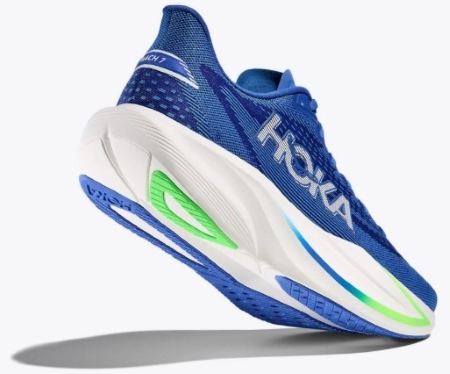
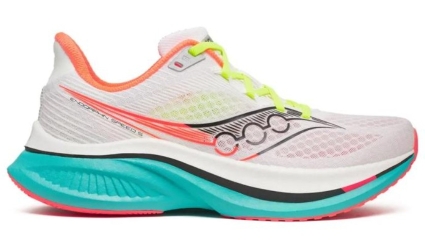
HOKA Mach 7 vs Saucony Endorphin Speed 5 comes down to how much help I want from the shoe during a workout. I choose the Mach 7 when I want to set the rhythm myself: strides, hill repeats, a controlled tempo, and the easy miles around them. I choose the Endorphin Speed 5 when the workout asks me to hold a quick rhythm for longer and I welcome the roll of its nylon-plated platform. For my own week, Mach is the easier shoe to live with; Speed 5 is the more compelling specialist for longer fast blocks.
I have 120 running miles in Mach 7 and 230 in Speed 5, both in men’s US 10.5 D. I run about 30–40 miles a week on South Jersey roads and boardwalks. Those logs let me describe what happened on my feet, including the days each pair disappointed me. They do not turn a shoe into a guaranteed pace gain for yours.
My choice before the workout starts
| What is on my calendar? | I would take | The condition that changes my mind |
|---|---|---|
| Easy miles with short strides or hills | Mach 7 | Its lower-drop feel or shaped midsole presses the foot |
| Continuous tempo or race-pace blocks | Endorphin Speed 5 | The plate and rocker feel intrusive at my target pace |
| Fartlek with frequent slow recoveries | Mach 7 | I want the Speed’s forward roll and it remains calm on the jogs |
| Faster long run or half-marathon rehearsal | Endorphin Speed 5 | Fit or control degrades after the foot warms |
| Very slow recovery or an all-purpose first shoe | Neither first | A calmer daily trainer fits that job better |
If the main purchase is ordinary daily mileage, I start with a daily trainer shortlist instead. Both shoes can cover more than one pace, but I would buy either for its best recurring job, not for the possibility that I might someday race more often.
The runs that made the difference
My clearest Mach 7 memory is climbing the Route 52 causeway on bridge repeats. The shoe turned over crisply on the incline while my heel stayed settled. I could decide when to press and when to back off. That is the kind of control I value in a workout shoe with no plate. On a hot 14-mile outing along the Brigantine causeway, though, sweat and swelling brought a small hot spot near my fifth metatarsal. The same close fit that felt secure early needed more scrutiny late.
Speed 5 felt different in a fartlek between Atlantic City piers. At roughly 6:45 per mile during the surges, the shoe found a fast rhythm quickly without feeling loose. Its harder test was a fast 5K session: when I pushed below roughly 6:30 per mile, I noticed more rotational bulk than I wanted for sharp intervals. That is why I call it a strong tempo and longer-block shoe without calling it my favorite for every kind of speed.
I tested each in the same size on familiar surfaces, but not in one perfectly matched experiment. Pair age, wind, heat and training fatigue change. The extra 110 miles in Speed 5 give me more confidence about its present wear, not a license to rank its absolute lifespan above Mach 7.
What my log actually settles: Mach gives me a more natural change of pace; Speed 5 makes sustained quick running easier to organize. My choice still depends on fit, the length of the fast segment and how the shoe behaves when the workout slows down.
Fit is my first veto
Both pairs worked at men’s US 10.5 D on my foot, but they do not hold it in the same way. Mach 7 seats me deeper in a shaped cradle. Its rearfoot feels secure, and the forefoot has enough room in normal conditions. That shape helped on the Route 52 climbs. The Brigantine hot spot reminds me that “true to size” is only a starting point; heat, swelling and sock thickness can change the final answer.
Speed 5 gives my toes usable width across the front and a contoured heel that stayed with me during faster running. I like being able to tighten the midfoot without crushing the front. Yet a forgiving toe box does not solve a sliding heel, and a secure heel does not excuse side pressure. I check both after walking and jogging long enough for the upper and my foot to settle.
- Mach 7 fails my fit test if the sidewall repeatedly presses my arch or outer forefoot. I will not lace harder and hope a structural pressure point disappears.
- Speed 5 fails my fit test if the foot moves forward on a broad turn or its midfoot hold only works with painful lace tension.
- Either shoe fails if I need extra length merely to create width. That can move the flex point and invite heel movement.
Both model lines have wide options in some markets, although stock varies by size and color. I would try the actual wide version before adding length, then repeat the heel-hold and turn checks; a wider upper is not an automatic fit cure. I use my running-shoe fit check before treating ride feel as the deciding factor. If width is the issue, my width guide is a better next step than blindly sizing up.
What the plate changes underfoot
Mach 7 uses supercritical EVA, a 5 mm listed drop and no plate. Speed 5 uses PWRRUN PB, an 8 mm drop and a full-length semi-rigid nylon plate. The Saucony also has a rocker-shaped transition. Those details explain why I expect different timing from them, but the material labels cannot tell you which stride will feel natural on your foot.
The construction details that affect my choice
| Detail | HOKA Mach 7 | Saucony Endorphin Speed 5 | What I check on the run |
|---|---|---|---|
| Midsole | Supercritical EVA | PWRRUN PB | Whether the ride stays coherent when pace changes or fatigue arrives |
| Plate | None | Full-length semi-rigid nylon | Whether I want free flex or a more guided transition |
| Brand-listed drop | 5 mm | 8 mm (36/28 mm stack) | How the complete geometry feels, rather than the printed gap alone |
| Upper | Creel jacquard with internal gusset | Light engineered mesh | Heel hold, forefoot pressure and heat after the foot warms |
| Outsole layout | Grippy forefoot rubber and heel Durabrasion rubber | Expanded heel coverage and a lengthwise groove | Contact and control on my actual road surface |
In Mach, I feel more able to vary how I land and leave the ground. The shoe is responsive without insisting on one turnover. On the bridge repeats, that freedom let me change effort with the grade. Speed 5 rewards a more settled cadence: once I am rolling at tempo, I stop thinking about individual steps. The plate does not make every mile quicker; it changes how the shoe flexes and how I feel the transition.
I treat the 5 mm versus 8 mm figures as brand-listed specifications, not a precise three-millimeter prediction for my calf. Measurement method, foot strike and the rest of the geometry can change the sensation. I have noticed more lower-leg demand when I bring Mach into a week too abruptly, so I give it time in the rotation and watch for discomfort. That is my response, not an injury forecast for another runner. My daily trainer versus tempo shoe guide explains why a versatile shoe still needs a primary assignment.
How I would assign them across a training week
Warm-up, recoveries and short pickups
On a day of drills, short hill repetitions or strides, I prefer Mach. I can jog the recovery without feeling that the shoe is waiting for me to speed up, then ask for a crisp push on the next rep. Speed 5 is capable of pace changes—the Atlantic City fartlek proved that for me—but its forward roll is more shoe than I need when the run spends most of its time easy. If your surges are the main event and your recoveries are brief, try Speed 5 too.
Continuous tempo and longer intervals
For a sustained tempo, I take Speed 5. Its plate and foam give me a repeatable rolling sensation after I have settled into the effort. Mach can absolutely handle tempo; it won my Route 52 workout by feeling tidy rather than dramatic. I pick it when I want to control the rhythm myself or when the session includes turns, hills and changing efforts.
I would not promise Speed 5 makes a given tempo pace easier for every runner. My test is whether I can hold form without fighting the shoe in the final block. I use the tempo-run guide to define that effort before choosing footwear.
Faster long runs and half-marathon rehearsal
Speed 5 gets my first try for a long run containing extended race-pace work. Its faster rhythm makes more sense when the hard portion lasts miles, not seconds. I have also taken Mach into long efforts; at 14 hot miles, fit—not bounce—became the limiting factor. The pair that wins my first three miles does not automatically win the last three. For either shoe, I check toe clearance, heel hold and whether the ride still feels centered after fatigue arrives.
A half-marathon rehearsal is a good reason to test Speed 5 before race day. It is not a reason to assume a nylon plate is identical to a carbon racing shoe. My race shoe versus daily trainer guide helps separate training utility from a goal-race decision.
Very fast 5K work and recovery days
For short, sharp 5K repeats, I do not hand Speed 5 an automatic win. My fastest session exposed a bulky turning sensation below about 6:30 pace. Mach feels more direct to me for a mixed workout, though I would still choose by the exact interval and surface. On a genuinely slow recovery day, I often leave both on the rack and use a calmer daily trainer. The best tempo shoe is not obliged to be the best recovery shoe.
Turns, heat and wear: my stop rules
The Mach’s secure cradle helps me hold a line on road camber and broad turns. Speed 5 held my foot well in the pier fartlek, but I still check its rocker and platform as fatigue changes my landing. Mach puts a grippier rubber compound under the forefoot and harder-wearing rubber at the heel; Speed 5 spreads more rubber across the heel and uses a lengthwise outsole groove. Those layouts are useful to inspect, but they do not prove which shoe grips a wet board better. On damp boards, painted lines and metal, I shorten the stride and judge traction separately from how the upper feels.
At 120 miles, my Mach has ordinary wear in the area where I land and still feels coherent. The upper has stayed together, though the hot 14-miler showed a fit limit. At 230 miles, Speed 5 has enough use for me to see outsole wear and current foam behavior without declaring it finished. I will replace either when grip, upper hold or ride changes meaningfully for my running; cosmetic creases alone do not decide it. My replacement guide explains the signs I watch.
Value follows the job. If I mostly run easy with one fast session, Mach may cover that session without asking me to buy a second plated trainer. If my calendar repeatedly includes long tempo blocks or race-pace rehearsals, Speed 5 earns its specialization. A sale price cannot make an intrusive ride or a pressure point disappear.
Who I would send to each shoe—and who I would turn away
| Runner’s real need | My recommendation | Why |
|---|---|---|
| One quick trainer for mixed workouts and some easy miles | Try Mach 7 first | More natural pace changes and less plate timing to manage |
| Repeated sustained tempo or long race-pace segments | Try Speed 5 first | Its rolling platform suits a settled fast rhythm |
| Sensitive to low-drop transitions or Mach sidewall contact | Test Speed 5, but verify fit | The different geometry may work better; fit still has veto power |
| Dislikes plated feel or wants more direct control | Try Mach 7 | No plate between foot and the changing workout |
| Most miles are recovery or relaxed daily running | Start elsewhere | Neither specialty is the center of that week |
If Mach sounds right but you want a freer forefoot and more playful short surges, my Mach 7 versus Rebel v5 comparison explores that adjacent choice. If you already know the model family you prefer, my individual Mach review and Endorphin Speed review go deeper than this head-to-head. I only add a second workout shoe when it fills a different weekly job; the rotation guide helps me check for overlap.
The try-on that would change my verdict
- First, warm the foot: use normal socks and jog at easy effort. I reject growing pressure, heel lift or toe contact before judging speed.
- Then run the real session: add a few short pickups and a sustained controlled segment. Mach should stay natural as effort changes; Speed should roll smoothly once rhythm settles.
- Finally, slow down: take a broad turn and jog the recovery. If I have to steer the shoe or negotiate the laces, that is the answer—even if the fast block felt brilliant.
I would record what happened late in the session and on the next normal run, then decide. A store sprint or one exciting mile can reveal potential; it cannot show whether I will want to repeat the workout in that shoe every week.
FAQ: Mach 7 or Endorphin Speed 5?
Is HOKA Mach 7 or Saucony Endorphin Speed 5 better overall?
For my mixed training week, Mach 7 is easier to use across changing paces. I choose Endorphin Speed 5 for sustained tempo and longer race-pace blocks. Fit and the workout on your calendar can reverse that choice.
Does the Endorphin Speed 5 nylon plate make it faster than Mach 7?
It gives me a more guided, rolling transition at sustained pace, but it does not guarantee a faster time. My own fast 5K session exposed a bulky feel in Speed 5. Test the interval length and pace you actually run.
Which shoe is better for easy runs?
Mach 7 is easier for me to jog in between faster work. I can run easy in Speed 5, but its rocker feels less necessary there. For mostly relaxed or recovery mileage, I would start with a calmer daily trainer.
Which fits wider feet better?
In my men’s US 10.5 D, Speed 5 gives usable horizontal toe room while Mach 7 has a secure shaped cradle. Neither description replaces a warm-foot try-on. Choose the width and last that hold your heel without pressing the forefoot.
Which is better for long runs?
I try Speed 5 first when a long run contains extended quick or race-pace blocks. Mach 7 works for longer running too, but my hot 14-mile outing produced a small forefoot hot spot. Late-run fit is the deciding test.
Which lasts longer?
I cannot give a lifetime winner from different-age pairs. My Mach 7 has 120 logged miles and Speed 5 has 230. I watch outsole grip, upper hold and ride changes rather than promise either an exact replacement distance.
What I would lace up tomorrow
Mach 7 for a varied workout; Endorphin Speed 5 for a sustained fast block. That is the choice my runs support. Mach lets me direct the effort and makes the jogs around it less awkward. Speed 5 helps me settle into a longer tempo or race-pace rhythm, provided its fit and rocker remain comfortable as I tire. I would not buy either because a plate, foam name or first-step bounce sounds impressive. I would buy the one that makes my recurring workout easier to execute from warm-up to cooldown.

Written by Ken — 12 years of running, 12,500+ miles, 63 shoes tested, 36 races from 5Ks to a 50K ultra. I run 30–40 miles a week on the Atlantic City Boardwalk and review every shoe with real training miles, not one-run demos. More about me →