
After 12 years of choosing shoes for workouts, races, and ordinary mileage, I use one clean distinction: a race shoe is built to improve performance near race pace, while a daily trainer is built to make weekly training repeatable with dependable comfort, control, and durability.
If I can own only one pair, I buy the daily trainer. If my daily mileage is already covered and I have a defined goal pace, I add a race shoe only after it proves a specific advantage in rehearsal.
That is the practical race shoe vs. daily trainer decision. One is not the premium version of the other. They solve different problems and fail in different ways.
Race shoe vs. daily trainer at a glance
| Decision factor | Race shoe | Daily trainer |
|---|---|---|
| Primary job | Performance at race pace | Repeatable everyday mileage |
| Typical construction | Low mass, resilient foam, stiffening element, aggressive rocker | More forgiving geometry, broader pace range, more durable upper and outsole |
| Best pace | Often improves as speed rises | Usually natural from easy to steady |
| Slow running | Can feel awkward or unstable | Core requirement |
| Cornering | Highly model- and fit-dependent | Usually more forgiving |
| Durability priority | Performance behavior | Long-term consistency |
| Transition demand | Often higher | Usually lower |
| Buying order | Second, after training is covered | First |
The category lines are not absolute. Some trainers are light and fast. Some race shoes are stable enough for long workouts. I decide by job, not paint color or price.
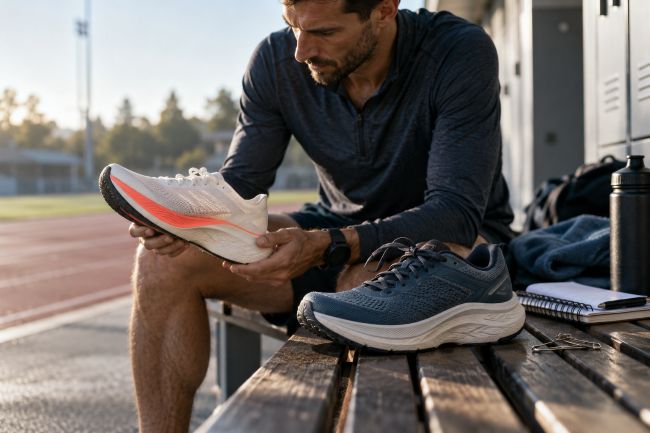
My two-gate decision
I do not begin with plate material, stack height, or price. I make the purchase pass two gates.
Gate 1: is ordinary training already covered?
I need a shoe that works when I am stiff, tired, warming up slowly, running easy, finishing long, or dealing with imperfect pavement. If no shoe in my rotation can handle that work reliably, I buy the daily trainer first.
A race shoe cannot rescue a training week undermined by poor fit or a daily shoe that makes easy mileage harder to repeat. The daily trainer earns priority because it touches more sessions and has more chances to help—or disrupt—the plan.
Gate 2: can I name the missing race-day advantage?
Once training is covered, I ask what the current shoe fails to provide at the target pace. I may want a quicker transition, lower mass, better late-race cushioning, a more stable race platform, or grip that suits the course.
“It feels exciting” is not enough. The candidate racer has to improve a defined part of execution without creating a larger problem in fit, steering, braking, or late-run comfort. If I cannot name and reproduce the advantage, I keep racing in the proven trainer.
This two-gate rule keeps the categories honest: the daily trainer supports the work; the race shoe must earn the specialist slot.
What makes a modern race shoe fast?
The plate gets the attention, but the plate is not the entire system.
A modern race shoe usually combines:
- Lightweight, highly resilient midsole foam
- A tall stack that stores more usable foam beneath the foot
- A stiff plate, rods, or another bending-control element
- Rocker geometry that times the roll toward toe-off
- A lightweight upper with minimal excess structure
- Outsole coverage placed only where the designer expects contact
- A shape tuned around faster running mechanics
Those parts interact. A stiff plate in dead foam does not create the same ride. Soft foam without a coherent plate or base may feel unstable. An aggressive rocker that misses my stride can make me work around the shoe.
My running-shoe energy-return guide explains why one rebound number cannot predict the complete race experience.
My article on carbon plate vs. nylon plate running shoes explains why plate material alone cannot predict the experience.
I judge the complete shoe at the pace it is supposed to serve. Walking around the house tells me about fit. It does not tell me whether the race system comes together at 5K, half-marathon, or marathon pace.
What a daily trainer is built to survive
Daily training is messy. It includes cold starts, stiff legs, recovery shuffles, strides, wet pavement, turns, road crown, stops, and tired finishes.
A good daily trainer has to remain useful across that variation. It often carries more outsole rubber, a more comfortable upper, a less aggressive transition, and a platform that tolerates imperfect landings.
I want my daily shoe to disappear. It should not demand a precise pace before it feels normal.
At 30–40 miles per week, this is the shoe that absorbs most of my actual running life. If it pinches, slips, or becomes unstable late, a spectacular racer does not repair the weekly foundation.
For faster training that sits between these categories, daily trainer vs. tempo shoe covers the middle ground.
The five differences I actually feel
1. Pace window
Daily trainers usually have a broad operating window. I can warm up slowly, settle into easy pace, add strides, and cool down without fighting the transition.
Race shoes are often narrower. The rocker, foam, and stiffness may feel disconnected at easy pace, then suddenly become coordinated when speed rises.
That narrow window is acceptable if it matches the race. It is a problem if the shoe feels good only during a few exciting accelerations.
2. Stability and steering
Tall compliant foam can create leverage. A race shoe needs flare, plate shape, outsole geometry, and upper hold to keep that stack manageable.
I test race shoes on the turns that exist in the actual event. Straight-line rebound means little if I brake before every corner or lose confidence on road crown.
Daily trainers generally give me more margin. Their platforms and uppers are designed for varied cadence and less tidy mechanics.
Runners who need more context should read modern stability shoes explained. A racing model can be inherently stable without carrying a stability label.
3. Fit and swelling
Race uppers remove material to save weight. That can create excellent lockdown, but it leaves less padding to hide a mismatch.
Secure does not mean cramped. I still need toe clearance, forefoot width, and enough volume for the foot changes expected over the race distance.
My moderately wide forefoot is the first checkpoint. If it sits beyond the platform or the upper pulls it inward, I do not accept the shoe because it feels fast.
I use the same loaded checks from my guide to how running shoes should fit, then raise the standard for the race’s actual pace and duration.
4. Durability and performance life
Daily trainers are usually engineered for repeated mileage. More rubber and a robust upper can add weight while preserving consistent behavior.
Race shoes may use exposed foam, thin rubber, and minimal uppers. They can remain runnable after their preferred race feel has softened, but cosmetic wear does not reveal the exact performance change.
I track role, not an arbitrary retirement number. A racer that loses its sharp target-pace transition may become a workout shoe if it remains comfortable and controlled.
5. Adaptation cost
A race shoe can change stack, drop, stiffness, rocker timing, foam compression, and leverage at once. The body still has to tolerate the new pattern.
Daily trainers tend to be less demanding, though no category guarantees an easy transition.
I never save a new racer for race morning. My transition to carbon-plated shoes protocol shows how I build exposure without turning every workout into a test.
Neither category owns comfort
Some runners assume daily trainers are comfortable and race shoes are harsh. Current shoes make that distinction unreliable.
A race shoe may feel softer and more protective because it uses a tall, compliant foam. A daily trainer may feel firmer because it prioritizes stability and long-term consistency.
Comfort is also pace-specific. A stiff rocker can feel awkward while walking and smooth at race pace. A soft trainer can feel pleasant easy and vague when I accelerate.
I rate comfort at three moments:
- Immediately after lacing
- At the intended pace
- Near the end of the intended duration
A shoe must pass all three moments for its assigned role.
Do you need a race shoe?
You do not need a dedicated race shoe to enter or finish a race. A comfortable, proven daily trainer is often the smartest option for a first event.
A race shoe becomes reasonable when:
- Weekly training footwear is already dependable.
- The runner has a specific event and target pace.
- Race-pace workouts occur regularly enough to test it.
- The model improves rhythm or effort without reducing control.
- Fit remains secure after swelling.
- The budget does not displace a more important training need.
Beginners gain far more from consistent training, pacing, sleep, and fueling than from treating a race shoe as mandatory equipment.
When product selection is justified, best carbon-plated running shoes organizes options by distance, stability, and ride rather than hype.
When the daily trainer should race
I would choose the daily trainer on race day when:
- The race shoe has not been tested at target pace.
- The daily trainer fits better after longer runs.
- The course is wet, technical, or full of tight turns.
- The racer causes calf, Achilles, arch, or forefoot concerns.
- The event is primarily an experience, not a performance attempt.
- Travel or budget makes one dependable pair more sensible.
Confidence has a performance value. A slightly heavier shoe I trust can be faster in practice than a fragile setup that changes my stride at every corner.
For first-time racers, the best daily trainer running shoes page is often the better shopping starting point.
My complete race-shoe test
I test the entire event sequence, not just fast repeats.
Step 1: fit at rest
I use race-day socks and the exact lacing I intend to race in. I check toe clearance, forefoot support, heel hold, tongue pressure, and whether the arch sits naturally.
A featherweight upper that requires painful lacing has already failed.
Step 2: easy warm-up
Races include walking, jogging, drills, and waiting. The shoe need not be luxurious, but it must remain manageable before the gun.
I note heel instability and whether the rocker forces me forward at slow pace.
Step 3: target pace
This is the core test. I run controlled segments at goal pace long enough to settle into rhythm.
I ask whether turnover feels easier, whether the platform remains centered, and whether the rocker meets my stride naturally. Watch pace alone is not enough; wind, route, and motivation distort a single run.
Step 4: pace changes
I accelerate, settle, and slow. Real races include congestion, hills, aid stations, and tactical changes.
A shoe that works only at one exact speed may still suit a flat time trial. It is less convincing for a varied course.
Step 5: braking and turns
I test left and right turns on dry pavement, then expected race conditions when safe. The heel should stay centered and the forefoot should remain over the base.
I include controlled deceleration. A tall shoe can feel very different while braking than while rolling forward.
Step 6: late-run fit
For longer races, I extend at least one rehearsal enough to expose swelling and fatigue. I practice grabbing fluids or fuel without losing confidence in the platform.
The final miles decide whether the upper is precise or restrictive.
Step 7: next-day response
I record unusual calf, Achilles, arch, forefoot, knee, or hip sensations. One response does not prove cause, but a repeated focal pattern limits exposure.
How much practice is enough?
There is no universal mileage requirement. The shoe must encounter the important demands of the event.
For a 5K, I prioritize race pace, fast cornering, acceleration, and secure fit. For a marathon, I care more about sustained comfort, late-run stability, swelling, fueling movements, and how the foam behaves after prolonged loading.
I want at least one uneventful full race-session rehearsal: warm-up, target work, pace changes, turns, and cool-down.
If any condition creates uncertainty, I repeat that condition. Familiarity is the goal; wearing out the shoe is not.
Can you train every day in race shoes?
You can train often in any shoe that fits, remains controlled, and is tolerated. That does not mean it is the best use of the tool.
Daily race-shoe use can:
- Spend performance-oriented outsole and foam life on easy miles
- Make slow running feel awkward
- Reduce the contrast between easy and hard days
- Concentrate exposure to one stiff, highly rockered geometry
- Leave no familiar backup if the racer develops a problem
There are legitimate reasons for frequent use. A runner may need familiarity, prefer that specific geometry, or own one versatile plated shoe.
I decide by workload and response, not by the claim that advanced technology is automatically better for every mile.
Carbon plate, nylon plate, or no plate?
Carbon plates tend to support a stiffer, more race-focused system. Nylon or composite plates often allow more flexibility and a broader pace range. Non-plated shoes can still use excellent foam and rocker geometry.
Those are tendencies, not guarantees. Plate shape, thickness, foam, stack, outsole, and the runner’s mechanics determine the result.
If stiffness bothers me or the course demands agility, I also consider the best running shoes without a carbon plate.
The correct question is not “Does it have carbon?” It is “Does this complete shoe help me execute this race?”
Course conditions can reverse the answer
A fast shoe in a straight dry test may be the wrong shoe for rain, sharp turns, uneven pavement, or sustained descents.
I inspect outsole rubber and test grip on representative surfaces. My outsole-rubber guide keeps those claims attached to the exact surface and condition. I also consider how wide the shoe is at contact points and whether its heel geometry catches on descents.
For crowded races, stability while changing lines matters. For shorter events, clean acceleration may matter more than long-run upper comfort.
Race rules can also govern stack height or eligible models. Those rules change, so I verify the current event and governing-body requirements. My World Athletics shoe-rules guide explains the verification path rather than treating an old limit as permanent.
The right buying order
My buying order is deliberately boring:
- Cover ordinary easy and steady mileage.
- Cover long-run needs.
- Identify the race and target pace.
- Find the performance gap in the current rotation.
- Test a race shoe that fills that exact gap.
If step one is unresolved, I do not skip to step five.
My running-shoe rotation guide helps assign distinct jobs without buying multiple versions of the same shoe.
When one shoe is enough
A versatile trainer is the right answer when budget, travel, low weekly volume, or simple training makes specialization unnecessary.
The one-shoe candidate should:
- Feel natural at easy pace
- Handle planned strides or race pace
- Remain stable late in longer runs
- Fit after swelling
- Grip the expected course
- Have enough durability for training
A small performance compromise can be worth the simplicity. The compromise fails when neither easy pace nor race pace feels natural.
Common buying mistakes
Buying the racer before solving fit
Premium foam cannot rescue cramped toes, heel slip, or a forefoot hanging off the platform.
Choosing by plate material
The shoe is a foam-plate-rocker-upper-outsole system. Carbon is not a complete ride description.
Testing only fast and fresh
Fast strides can hide poor warm-up behavior, cornering, swelling, and late-run instability.
Assuming the lightest shoe is fastest
Low mass helps, but a shoe that disrupts mechanics, grip, or confidence can erase that advantage.
Retiring by mileage alone
I track changes in race-pace behavior, control, fit, and grip. An odometer does not know the surface, runner, or shoe construction.
Racing in something new
Race morning is execution day. It is not the time to learn where a rocker engages or whether an upper swells badly.
What if the categories overlap?
Some shoes blur the decision. A lightweight daily trainer may race well. A super trainer may use premium foam and a plate while remaining durable enough for frequent workouts. A stable race shoe may feel more forgiving than an aggressive trainer.
I still assign one primary job. If the shoe must tolerate easy starts, recoveries, and routine mileage, I judge it by trainer standards. If I bought it to improve target-pace execution on race day, I make it pass the full race rehearsal.
My super shoes versus super trainers comparison handles that narrower overlap. The label can be fuzzy; the job, failure mode, and buying order should not be.
My bottom line
A daily trainer makes the training plan repeatable. A race shoe is a specialist that may make race-pace execution more efficient.
I buy the daily trainer first. Then I add a racer only when it fits, survives the complete race-session test, handles the actual course, and offers an advantage I can feel repeatedly at target pace.
The fastest shoe is not the most expensive or aggressive one. It is the shoe that lets me run the race without negotiating with my feet.

Written by Ken — the recreational distance runner behind NextGait. My shoe-role guides combine 12 years of running decisions with complete-session rehearsals, surface-specific checks, and a simple rule: specialist shoes must earn their place through repeatable execution. More about me →