
Does cushioning reduce running impact? Yes, it can—but “more foam equals less impact” is the wrong conclusion. A shoe can soften the first sensation underfoot while leaving peak force unchanged, moving load to a different part of the leg, or making me stiffen to control the platform. After 12 years of running and testing shoes, I judge cushioning as a complete system: foam, stack, width, geometry, pace, surface, and the way my body responds together.
That distinction matters. I do not buy a shoe because it feels like a pillow for ten steps in a store. I buy it when the cushioning stays controlled through the run I need it to do—and when my body is no worse later that day or the next morning.
My answer in one sentence
Cushioning can reduce or redistribute some forms of impact for some runners, but stack height and softness alone cannot tell me whether a shoe reduces harmful load or injury risk.
| What I can reasonably infer | What I cannot infer |
|---|---|
| A softer or thicker midsole changes how the shoe deforms. | That every force measured at the body is lower. |
| A wider base can make deep cushioning easier to control. | That a tall shoe is automatically stable. |
| A shoe may make the landing feel less harsh. | That perceived softness proves lower injury risk. |
| Pace, fatigue, surface, and technique change the result. | That one laboratory number predicts every runner. |
| A controlled shoe can improve comfort over a specific run. | That cushioning can repair a training-load error. |
Why “impact” is a slippery word
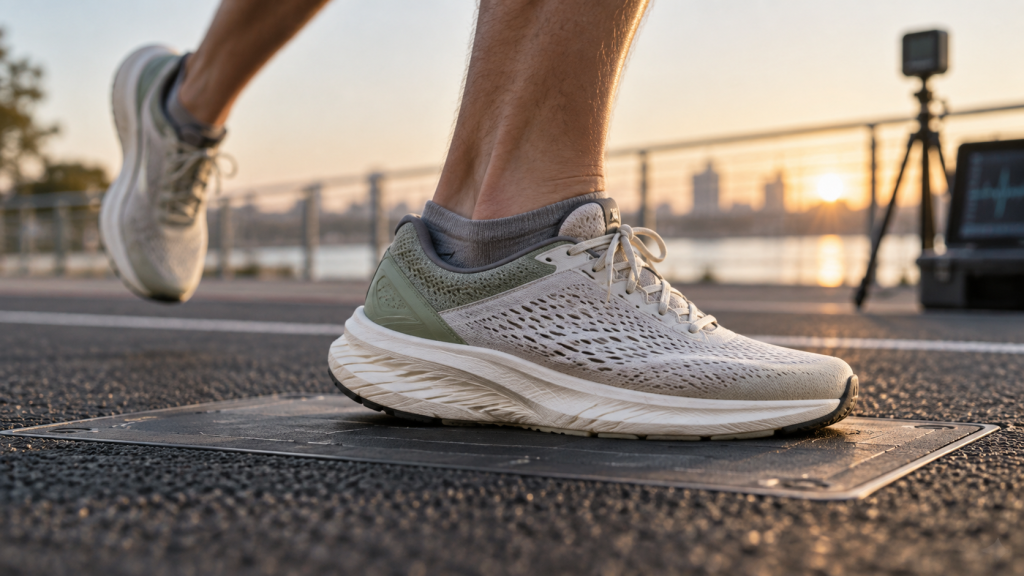
When runners ask whether cushioning reduces impact, they often mean one of three different things: “Will the landing feel softer?”, “Will a force plate show a smaller spike?”, or “Will this shoe keep me from getting hurt?” Those are not the same question.
A laboratory can measure vertical ground-reaction force, how quickly that force rises, pressure under part of the foot, acceleration at the tibia, joint motion, or joint moments. Each describes one part of the event. None is a universal “damage meter.” My body also adapts: I can change leg stiffness, cadence, contact position, and muscle activity without consciously deciding to do it.
This is why apparently conflicting results do not surprise me. A softer shoe can delay one part of the force trace while another value stays similar or even rises. The runner and shoe form one system, not two isolated objects. I explain that interaction more fully in my guide to running biomechanics.
The four things runners keep mixing together
1. Softness
Softness is how easily the midsole yields when I load it. It creates an immediate sensation, which is why it sells shoes so effectively. But a very soft foam can compress too far, recover slowly, or let my foot travel sideways. Softness is a feel—not a complete measure of protection.
2. Stack height
Stack height is the amount of material between my foot and the ground. More depth gives the designer more material to work with, but it also raises my foot and can increase leverage when the platform tips. The practical effects depend on foam stiffness, sidewalls, base width, rocker, and where the stack is placed. My running shoe stack-height guide is the deeper companion to this question.
3. Cushioning
Cushioning is the system’s ability to deform under load and manage that deformation. I care about how much it compresses, how quickly, in which direction, and whether it behaves the same way after 60 minutes as it did after six.
4. Comfort
Comfort is my whole-body verdict. Fit, upper pressure, heel hold, rocker timing, temperature, stability, and familiarity all influence it. I take comfort seriously, but I do not let a plush first impression overrule a sliding heel, cramped toes, or a platform that becomes vague when I tire. If the fit is wrong, I fix that before debating foam; my toe-box fit guide shows the checks I use.
What actually happens when the shoe compresses
At contact, the midsole deforms while my ankle, knee, hip, muscles, and tendons manage the rest of the landing. If the foam compresses in a controlled way, it can spread part of the loading over time and make the contact feel smoother. Then it has to stabilize and return toward its original shape so I can move through stance.
The key phrase is in a controlled way. At 182 pounds, I can expose a foam’s limits quickly. If it collapses deeply under my heel but the sidewall and base do not contain that movement, the shoe may feel luxurious while I am standing and imprecise once I run. My mildly wide forefoot and slightly greater inward roll on the left make that loss of control especially obvious late in a session.
I call good cushioning quietly competent. I notice the landing is comfortable, then I stop thinking about the shoe. Bad cushioning demands attention: I search for a stable landing, grip with my toes, avoid corners, or feel one side sink more than the other.
My cushioning decision lab: five readings, not one feeling
I use a five-reading audit whenever two shoes feel similarly comfortable. This is not a laboratory test and I do not pretend it measures force. It is a repeatable way to decide whether the cushioning works for my body and the intended run.
| Reading | What I ask | Failure signal |
|---|---|---|
| Contact | Does the landing feel smooth rather than sharp? | Harsh slap, localized pressure, or bottoming. |
| Centering | Does my foot stay centered over the platform? | Sideways drift, ankle search, or toe gripping. |
| Transition | Can I roll forward without fighting the shoe? | Heel hanging back, rocker arriving too early, or forefoot stiffness. |
| Fatigue | Does the ride remain predictable late in the run? | Foam feels flatter, wobblier, or slower to recover. |
| Aftermath | Is my normal later-day and next-morning response unchanged? | New repeatable soreness, pressure, or altered walking. |
Reading 1: contact
I start at easy pace on a familiar flat route. I am not looking for maximum softness. I want the contact to feel smooth and spread out, with no small area under the heel or forefoot taking all my attention. A shoe that bottoms out produces a distinct “through the foam” sensation; adding more miles rarely improves it.
Reading 2: centering
Next I watch what happens on gentle turns, road camber, and a mild downhill. Deep foam needs enough base width and structure to keep me centered. If my left side rolls farther as fatigue builds, or if I shorten my stride only to control the shoe, the cushioning is creating work rather than removing it.
Reading 3: transition
Cushioning does not act alone after landing. Bevels and rocker geometry determine how I move forward. A rocker can make a thick shoe feel smoother, but only when its curve begins in the right place for my stride. I use my running shoe rocker guide when a shoe feels protective yet strangely difficult to roll through.
Reading 4: fatigue
A ten-minute test tells me almost nothing about long-run cushioning. I need to know whether the platform remains predictable after the foam is warm and my own control is declining. I pay attention to the final third of the run: the moment when a pleasant shoe can become mushy, flat, or unstable.
Reading 5: aftermath
I record location and timing, not just “felt good” or “felt bad.” Was there calf tightness two hours later? Did the arch feel pressed only on the left? Was the next morning normal? One odd run is a clue, not a verdict. The same response twice under similar conditions is a pattern I respect.
Run the comparison in two sessions
- Choose equal jobs. Compare two daily trainers, not a recovery shoe with a racing shoe.
- Keep the route and effort familiar. Similar pace, surface, duration, and weather make the signal easier to read.
- Use the correct size. Lock the heel without crushing the forefoot; poor fit can imitate instability.
- Run the five-reading audit. Note contact, centering, transition, fatigue, and aftermath.
- Swap the order on the second session. This reduces the chance that novelty or tired legs decide the result.
- Choose the fewer-compromise shoe. I do not award the win to the softest ride. I choose the shoe that stays comfortable and controlled for its actual job.
When more cushioning helps—and when it gets in the way
| Situation | What I usually want | What I avoid |
|---|---|---|
| Easy or recovery run | Comfortable contact, broad base, low mental effort. | Deep softness that makes the ankles work. |
| Long run | Resilient foam that stays composed when warm. | A ride that fades or drifts in the final miles. |
| Tempo work | Enough cushioning with a quick, predictable transition. | Foam that absorbs the rhythm and feels delayed. |
| Sharp turns or uneven roads | Secure upper, lower leverage, clear centering. | Tall narrow platforms and loose uppers. |
| Concrete-heavy route | Comfort I can control for the full duration. | Choosing the softest shoe solely because the surface is hard. |
| New or returning runner | Familiar geometry and gradual exposure. | Changing shoe type and training load at the same time. |
If I decide a highly cushioned shoe is the right tool, I then compare complete models—not foam marketing—in my guide to the best cushioned running shoes.
Does a softer shoe prevent running injuries?
I would never promise that. Injury is an outcome of exposure, capacity, recovery, health, previous injury, training choices, surface, and equipment interacting over time. A shoe can change load, but “changed” does not always mean “lower,” and lower in one measurement does not mean lower everywhere.
The honest takeaway is that simple stories fail: a softer shoe can be associated with a better injury outcome even when familiar impact metrics do not fall. To me, that is a warning against shopping from a single laboratory value or a dramatic marketing percentage.
My practical rule is narrower and more honest: I use cushioning to improve comfort and control for a defined running job; I use training decisions to manage training load. If pain is focal, worsening, changes my gait, appears at rest, or keeps returning, I do not try to solve it by adding more foam.
What about body weight and foot strike?
Heavier runners
Greater body mass does not create a prescription for the tallest or softest shoe. It makes under-load behavior more important. I look for enough material to avoid bottoming, enough resilience to recover, a broad enough platform to control compression, and an upper that keeps the foot centered. Firm-but-controlled often works better than soft-but-collapsing.
Heel strikers
I check rearfoot compression, heel bevel, and the transition out of the heel. A thick heel that catches the ground or collapses unevenly can feel worse than a moderately cushioned heel with cleaner geometry.
Midfoot and forefoot strikers
I inspect forefoot depth, flex or rocker location, toe-box security, and whether the heel interferes with the stride. Changing foot strike just to chase a supposedly lower impact number is not my solution; it redistributes demand, including toward the calf and Achilles.
Seven cushioning claims I reject
- “Maximum stack means maximum protection.” Stack is depth, not a safety score.
- “The softest shoe absorbs the most shock.” The runner may adapt, and the platform may lose control.
- “A quiet footstrike proves low impact.” Sound and biomechanical load are not interchangeable.
- “Concrete requires max cushioning.” Surface matters, but the shoe still has to fit the runner and session.
- “More cushioning fixes knee pain.” Pain location does not identify one shoe feature or one cause.
- “Heavier runners always need firmer shoes.” Body mass matters under load, but geometry, pace, fit, and preference still change the answer.
- “If it feels good in the store, it will work for a long run.” Warm foam and tired legs reveal behavior that standing cannot.
Frequently asked questions
Does more cushioning reduce impact when running?
Sometimes, depending on the measurement, shoe, runner, speed, and surface. More cushioning can soften or delay parts of the landing, but it does not guarantee a lower peak force, loading rate, joint load, or injury risk in every runner.
Is a higher stack height more cushioned?
It contains more material underfoot, but that does not tell me how soft, resilient, stable, or protective the ride will feel. Foam formulation, platform width, geometry, and outsole construction all matter.
Is soft or firm cushioning better?
Neither is universally better. I choose the degree of softness that remains centered, transitions smoothly, and stays consistent for the intended duration. I reject both harsh firmness and unstable softness.
Are max-cushioned shoes better for concrete?
They can improve comfort on a hard route, but maximum stack is not mandatory. A moderately cushioned shoe that fits securely and stays stable may be the better choice.
Can cushioning prevent knee pain?
No shoe feature can promise that. Cushioning changes the running system and may improve comfort, but recurring knee pain needs a broader look at training load, strength, recovery, mechanics, and clinical factors.
How do I know if cushioning is too soft?
I treat sideways drift, toe gripping, uncertain turns, delayed transition, bottoming, or a ride that becomes vague with fatigue as warning signs. Softness is acceptable only while control remains easy.
Can a smartwatch measure running impact?
A watch can estimate useful movement metrics, but it does not replace a force plate or full biomechanical assessment. I use wearable trends to compare my own runs, not to certify that one shoe prevents injury.
My final decision
Cushioning is useful when it makes the landing comfortable without making the rest of the stride harder to control. I do not chase the tallest stack, the lowest durometer, or a single impact number. I look for controlled compression, secure centering, a natural transition, consistency under fatigue, and a normal recovery response.
That is the standard I trust after 12 years: the shoe should manage its own cushioning so I can manage the run.

Written by Ken — 12 years of running, 12,500+ miles, 63 shoes tested, 36 races from 5Ks to a 50K ultra. I run 30–40 miles a week on the Atlantic City Boardwalk and review every shoe with real training miles, not one-run demos. More about me →