
This running shoe rotation guide starts with a rule that has saved me more money than any sale: every shoe must earn a job. After 12 years of running, I do not build a rotation by collecting categories. I build the smallest system that covers the runs I actually complete, gives me a dependable backup, and tells me quickly when a shoe no longer belongs.
For many runners, that system is one versatile daily trainer. For others, it is a daily shoe plus one specialist. I add a third pair only when a third recurring demand is visible in my training log. More boxes can create more choice, but they do not automatically create better decisions.
My rotation answer in 30 seconds
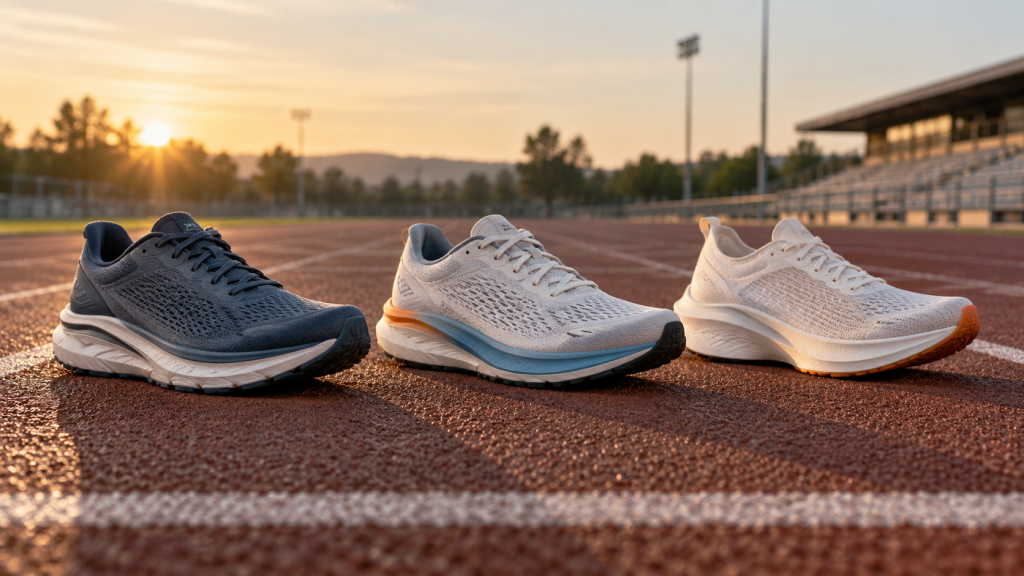
I use one shoe when my routes, paces, and distances are similar. I use two when the first shoe has one repeated limitation—perhaps it feels cumbersome in workouts, loses control late in long runs, lacks wet grip, or cannot handle trail terrain. I use three when training and racing contain three genuinely different jobs often enough to justify them.
| What my week looks like | Smallest useful rotation | What must be true |
|---|---|---|
| Three similar easy runs | One daily trainer | Fit, grip, and control remain dependable across every run |
| Easy mileage plus a weekly workout | Daily trainer + tempo shoe | The faster shoe produces a clear, repeatable advantage at workout effort |
| Easy runs plus long runs | Daily trainer + long-run shoe | The second shoe stays comfortable and controlled as time increases |
| Training plus goal racing | Daily trainer + tested race shoe | Race-day fit and behavior have been rehearsed |
| Road and trail | Road trainer + trail shoe | Terrain creates a real grip, protection, or hold requirement |
| Easy, workout, and race roles | Three-shoe rotation | Each role occurs often and each shoe has a distinct contract |
I do not use weekly mileage alone as the trigger. A runner at 20 miles per week may need a trail shoe because of terrain. A runner at 50 miles per week may still cover nearly everything in two reliable trainers. The schedule creates the jobs; the internet does not.
The rotation audit card I use
Before I buy or keep a shoe, I run it through five questions. I call this my rotation audit card: Job, Gap, Proof, Cost, Exit. It turns an exciting product into a practical decision.
Job: what recurring run owns this shoe?
I name the session, surface, and condition. “Fast shoe” is too vague. “Tuesday threshold sessions on dry road” is a job. “Backup for wet easy runs” is a job. If I cannot write the assignment in one sentence, I am not ready to buy.
Gap: what fails in the shoes I already own?
I describe the existing limitation without marketing language. Does my daily shoe feel unstable after 90 minutes? Does it slip on wet pavement? Does it make controlled faster running feel clumsy? A second shoe should close a repeated gap, not manufacture a new need.
Proof: how will the shoe earn full duty?
I decide the test before the first run: loaded fit, an easy familiar route, the intended pace, the intended duration, and a next-day check. A pleasant first mile is not proof that a shoe belongs in a marathon block.
Cost: what am I paying per useful job?
I care less about price in isolation than about frequency and consequence. A daily trainer used four times each week can justify more budget than a beautiful racer I rarely wear. My guide to whether expensive running shoes are worth it applies this same value test without assuming that higher price means better fit.
Exit: when will I reassign or remove it?
I set functional exit criteria: lost grip, compromised hold, a persistent fit problem, a ride that no longer serves its job, or a redundant role. That keeps sentiment and sunk cost from running the rotation.
Step one: map the last four weeks, not the next fantasy
I open my training log and list the runs I actually completed during the previous four weeks. I group them into easy/recovery, long, tempo/threshold, intervals, race-specific, trail, and weather-specific sessions. Then I count frequency.
A role that appeared six times last month deserves attention. A role that appeared once may be handled by the most versatile existing shoe. The exception is when terrain, weather, or race requirements make the wrong tool a meaningful control problem.
I also ask which session generated the clearest footwear complaint. If the answer is “none,” I do not force expansion. I would rather have one trusted pair than two shoes whose differences exist mostly on a product page.
Step two: write a one-sentence role contract
Every shoe in my rotation gets this sentence:
I use this shoe for ___ because it does ___, and I avoid it for ___ because it does ___.
My daily trainer might read: “I use this shoe for easy and steady road mileage because it stays natural across paces, and I avoid it for wet intervals because its grip becomes uncertain.” My tempo shoe might read: “I use this shoe for controlled faster work because it changes rhythm cleanly, and I avoid it for recovery runs because the forefoot feels too directive.”
If two shoes receive almost the same sentence, I investigate redundancy. One can become a backup, but I do not pretend duplication is specialization.
The one-shoe rotation: simplicity is a feature
I recommend one dependable daily trainer when a runner is new, runs similar routes, or has not found a recurring limitation. One shoe makes cause and effect easier to read. If discomfort appears, I have fewer changes to untangle.
For full duty, I want secure heel and midfoot hold, usable toe room after swelling, natural movement at easy pace, adequate grip for local conditions, and enough range for short controlled pickups. I also want the shoe to remain predictable near the end of the longest routine run.
If that role is currently empty, I begin with my daily trainer shortlist. I am not searching for the shoe that wins every laboratory measure. I am searching for the pair that creates the fewest compromises in the runner’s real week.
The two-shoe rotation: where most value lives
Two shoes cover most recreational training cleanly. The daily trainer absorbs ordinary mileage; the second pair solves the most frequent unmet demand. I choose the pairing from evidence in the log.
Daily trainer + tempo shoe
I use this when easy mileage is already comfortable but sustained faster running feels delayed or laborious in the daily shoe. The tempo pair should transition smoothly at workout effort without becoming awkward during warm-up and recovery. My daily trainer versus tempo shoe comparison defines that boundary without relying on a brand label.
Daily trainer + long-run shoe
I add this pair when the daily shoe loses forefoot depth, fit security, or control late in longer runs. I do not assume maximum stack automatically solves the problem. I test how the shoe behaves after swelling and fatigue, not only how soft it feels at the door.
Daily trainer + race shoe
I use this when ordinary training is covered and goal racing is important enough to rehearse. The racer must prove fit, cornering, grip, target pace, and late-run behavior before race morning. My race shoe versus daily trainer guide explains why I cover training first and specialization second.
Road trainer + trail shoe
This is a true surface split. Lugs, rock protection, upper hold, and off-camber control can create a job a road shoe cannot serve well. I match the trail pair to local ground rather than buying the most aggressive outsole available. New trail runners can use my trail-running decision system to separate terrain needs from trail aesthetics.
Two daily trainers
I use two mileage shoes for backup, wet-weather turnover, or a controlled difference in ride. The pair can be identical if the purpose is availability and drying. If I want training variety, I choose differences I already tolerate rather than maximizing contrast.
When a third shoe earns its place
A third pair earns admission only when I can point to three recurring jobs and three different contracts. Common systems are daily/tempo/race, easy/long/race, road mileage/trail/race, or two mileage shoes plus one workout tool.
I use a monthly frequency test: How many times did I need this job, and what specifically went wrong when another shoe covered it? If I cannot answer both parts, I delay the purchase. Beyond three pairs, my standard becomes even stricter because each shoe receives fewer runs and condition becomes harder to track.
Plate material alone does not define a role. A flexible plated trainer and a rigid racer can behave very differently even if both contain a plate. When stiffness is part of the decision, I use my carbon versus nylon plate comparison to evaluate the whole geometry rather than buying a material name.
How different should the shoes be?
I want meaningful variation, not maximum variation. Shoes can differ in drop, stack, foam firmness, rocker, longitudinal stiffness, platform width, guidance, outsole, or upper volume. A useful difference helps one pair perform its assigned job. An arbitrary difference creates another adaptation problem.
I change one major variable at a time when possible. Jumping from a structured high-drop trainer to a flexible zero-drop shoe while also increasing speed and volume gives me too many explanations for any response. If drop changes substantially, I use my heel-drop transition protocol instead of dividing mileage by an automatic formula.
Comfort matters, but I treat it as a screening input rather than a guarantee. A shoe should feel acceptable on the foot and remain acceptable during its real job. My explanation of the running-shoe comfort filter shows where personal preference helps and where it can be oversold.
Rotation does not come with an injury guarantee
I have seen the claim that rotating shoes prevents injuries presented as settled fact. I do not write it that way. Observational data can find an association between using multiple pairs and fewer injuries, but that design cannot prove the extra shoes caused the difference. Runners who rotate may also train differently, have more experience, cross-train more, or manage load more carefully.
Different shoes can change the mechanical experience, but “different” does not automatically mean “protective.” A random mix of uncomfortable geometries is not a health strategy. I rotate for job matching, comparison, drying, backup, and controlled variation. My article on whether running shoes prevent injuries keeps the broader promise in proportion.
No rotation corrects abrupt mileage increases, inadequate recovery, worsening pain, or a training plan that exceeds current capacity. If a shoe repeatedly produces focal pain, gait change, numbness, or symptoms that continue outside running, I stop testing and seek appropriate assessment.
My seven-run introduction protocol
I do not assign a new shoe its full job after one exciting run. I use seven controlled exposures, extending the process whenever the response is unclear.
- Define the contract. I write the intended role, pass conditions, and situations to avoid.
- Check loaded fit. I use real socks and confirm heel hold, toe space, arch contact, and platform coverage.
- Run short and familiar. I keep route and effort ordinary so the shoe is the main new variable.
- Repeat easy exposure. I check whether the first impression remains consistent rather than chasing novelty.
- Touch the intended job. I add a small dose of workout pace, duration, or terrain after warming up.
- Increase one demand. I add either duration or intensity, never both merely to finish the test faster.
- Earn full assignment. I grant the complete role only when fit, control, surface behavior, fatigue, and next-day response remain acceptable.
I keep a known shoe active during this process. That familiar pair is my control and my fallback. It also prevents new geometry from taking over the entire week at once.
The weekly selector: how I choose today’s pair
Before each run, I make the selection in this order: session purpose, surface and weather, current shoe condition, then personal response. Price and novelty do not get a vote.
- Easy day: I choose the shoe that feels natural slowly and does not encourage me to turn recovery into a workout.
- Quality day: I choose the tested pair that handles the intended rhythm, turns, and surface.
- Long run: I prioritize sustained fit, grip, and control under fatigue.
- Race rehearsal: I use the planned race setup early enough to solve problems.
- Wet or rough conditions: I let grip and upper hold override the schedule’s ideal shoe label.
I do not assign fixed mileage percentages to categories. If four of five runs are easy, the daily trainer naturally receives most work. A specialist gets the sessions that justify it, not extra mileage because it cost more.
My monthly five-column review
Once each month, I review Frequency, Function, Response, Condition, and Redundancy. This is the maintenance loop that keeps a rotation from turning into storage.
| Column | Question I ask | Decision it can trigger |
|---|---|---|
| Frequency | How many runs did this shoe receive? | Keep, question the role, or stop adding similar pairs |
| Function | Did it handle its assigned pace, duration, surface, and weather? | Keep the role, narrow it, or reassign it |
| Response | Did pressure, calf demand, instability, or next-day discomfort repeat? | Modify exposure or remove it from the role |
| Condition | Have grip, hold, structure, or ride meaningfully changed? | Downgrade, replace, or retire |
| Redundancy | Do two shoes now solve the same job? | Use one as backup or stop buying duplicates |
I record date, shoe, session role, distance or duration, surface, weather, one ride note, and one next-day note. Consistent short entries tell me more than a complex spreadsheet I stop using.
Retirement is a job decision, not a mileage alarm
Mileage provides context, but I do not retire every shoe at one universal number. Runner mass, surface, gait, construction, use, weather, and role all affect what changes first. I look for functional drift.
I ask whether the long-run shoe still preserves control, whether the tempo shoe still changes rhythm cleanly, whether wet grip has changed, whether the upper still centers my foot, and whether the platform leans or compresses unevenly. My running-shoe lifespan guide provides the full inspection sequence.
A race shoe may move to workouts. A long-run shoe may move to short easy outings. I downgrade only when the new job remains safe, comfortable, and predictable. I retire the shoe when it cannot serve any role with confidence.
Budget order: buy coverage before specialization
I spend in this sequence: the shoe covering most weekly mileage, the recurring job it handles poorly, a meaningful surface or weather gap, then race specialization. I introduce one new pair at a time so I can interpret the response.
I am happy to buy a previous model when fit, storage, condition, and the model change are understood. My guide to buying last year’s running shoe is the value check I use before assuming the newest version deserves the budget.
I do not buy two untested shoes simultaneously to “complete” a rotation. That creates two new geometries and no stable comparison. The rotation grows one solved problem at a time.
Frequently asked questions
How many running shoes should I rotate?
I start with one dependable daily trainer. I add a second for a frequent job the first shoe handles poorly, and I add a third only when another distinct demand appears regularly in my actual training.
Is rotating running shoes better than using one pair?
It can improve task matching, backup, drying, and comparison, but one suitable shoe may cover a simple week perfectly well. A rotation does not guarantee better health or performance.
Should my rotation shoes have different heel drops?
They can, but the difference should serve a job and be introduced deliberately. I do not maximize contrast for its own sake, especially when drop, stiffness, stack, and guidance all change together.
Can I rotate two identical pairs?
Yes. Two identical pairs can provide backup and allow a wet shoe to dry. They offer less task variation than two distinct roles, but that may be exactly what the runner needs.
Do running shoes need 24 or 48 hours to recover?
I do not use a universal clock. Foam, construction, load, temperature, and moisture differ. Alternating pairs remains practical for drying and backup without promising that a fixed waiting period extends every shoe’s life.
Which shoe should receive the most mileage?
The shoe assigned to the most frequent job should receive the most work. For most runners that is the daily trainer, while workout and race shoes receive only the sessions that justify their roles.
When should I remove a shoe from the rotation?
I remove or reassign it when fit, grip, hold, structure, or ride changes enough that it no longer performs its job predictably, or when another shoe has made the role genuinely redundant.
My final decision
The best running-shoe rotation is not the largest one. It is the smallest set that makes every recurring run easier to assign and easier to evaluate.
I start with one reliable daily trainer. I add a shoe only after I can name the job, the current gap, the test, the value, and the exit. Then I review the system monthly and remove roles that no longer exist.
A collection asks, “What else could I buy?” My rotation asks, “What job still needs a tool?” That is the question I trust.

Written by Ken — a running specialist with 12 years of experience, 12,500+ miles, 63 shoes tested, and 36 races from 5K to 50K. I assign shoes by the work they improve across a real training week, not by the category printed on the box. More about my testing approach.
Pingback: HOKA Mach 7 vs New Balance Rebel v5: My Workout Verdict