
For the most complete running tool, I pick the Garmin Forerunner 970. For most road runners, I would spend less on the Forerunner 570. If a lighter watch and value come first, I would buy the COROS PACE 4. The right GPS watch is the one that solves your actual training problem—not the one with the longest feature list.
I rank these watches by what I can use mid-run: readable pace and laps, reliable controls, route decisions, sensible battery headroom and a comfortable fit. Manufacturer specifications inform the comparison; I do not present unlogged head-to-head GPS mileage as personal test results.
Quick picks: the three GPS watches I would shortlist first
| My pick | Best for | Why I would buy it | Price |
|---|---|---|---|
| Garmin Forerunner 970 | Best overall | Deep running tools + real maps | Check price → |
| Garmin Forerunner 570 | Most road runners | Training depth without paying for full maps | Check price → |
| COROS PACE 4 | Lightweight value | Compact build, dual-frequency GPS, updated maps | Check price → |
Jump to a section
10 Best GPS Watches for Running: In-Depth Reviews
I use “best” as a fit judgment, not a universal score. Battery figures below are manufacturer ratings in the named modes, so I would never compare them as if every watch used identical GPS, display and sensor settings.
1. Garmin Forerunner 970 — Best full-featured running watch
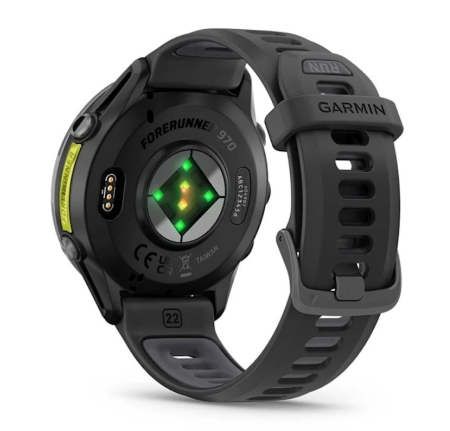
| Spec | What matters |
|---|---|
| Display | AMOLED |
| GPS | Multi-band |
| Navigation | Offline maps |
| Battery reference | Up to 21 h all-systems + multi-band |
Why I chose it: I put the Forerunner 970 first because it handles the jobs that usually force a runner to compromise: structured training, route navigation, race pacing and a readable screen. It is the watch I would choose when a run can become a long, unfamiliar route and I still want serious training tools at the finish.
The map is the real upgrade over a midrange Forerunner. I can follow a route at a junction rather than interpreting a thin breadcrumb line. Garmin’s newer running-economy and step-speed-loss metrics require a compatible HRM 600 chest strap; I would not buy the watch solely for those numbers. Its battery claim here is Garmin’s all-systems-plus-multi-band mode, not a promise for every setting.
- What I like: Excellent blend of training depth, maps and five-button control; useful race-day features.
- What I do not like: Expensive, and a touchscreen map is less pleasant with wet fingers; advanced metrics add accessory cost.
- Buy it if: You race, travel with routes, or want one watch for training and navigation.
- Skip it if: You run familiar roads and will never open a map; the 570 buys the better value.
2. Garmin Forerunner 570 — Best for most road runners
| Spec | What matters |
|---|---|
| Display | AMOLED |
| GPS | Multi-band |
| Navigation | Course guidance; no full offline maps |
| Battery reference | Up to 13–14 h all-systems + multi-band |
Why I chose it: If a runner asks me what to buy without a long list of requirements, I start here. The 570 gives me the training workflow, readable AMOLED screen, physical buttons and multi-band positioning that matter on ordinary roads, without paying for the 970’s full mapping package.
I would use it for intervals, progression runs and a half-marathon build. The decision point is navigation: course following is not the same as seeing surrounding streets on an offline map. Battery also depends on case size and satellite mode; the shorter figure applies to the 42 mm version in multi-band mode, so I would check my intended setup before an ultra.
- What I like: Focused running interface, useful training tools and two case sizes.
- What I do not like: No onboard full-color offline maps; battery is modest beside endurance-focused watches.
- Buy it if: You run mostly known roads and want a capable training watch without a flagship price.
- Skip it if: You regularly navigate unfamiliar trails; choose the 970 or a mapped alternative.
3. COROS PACE 4 — Best lightweight value
| Spec | What matters |
|---|---|
| Display | AMOLED |
| GPS | Dual-frequency |
| Navigation | Offline maps after October 2026 update |
| Battery reference | Up to 31 h dual-frequency GPS |
Why I chose it: I like the PACE 4 for a runner who wants a light watch that disappears on the wrist and still offers meaningful GPS and training capability. Its October 2026 update added downloadable global maps, which changes this recommendation: I no longer treat it as a breadcrumb-only model.
I would download the region and test the route before leaving Wi-Fi; maps stored on a watch are only helpful when the needed area is actually there. The PACE 4 Pro gives a larger, quicker map-oriented experience, but the standard PACE 4 is the more economical and lighter-feeling choice for everyday training.
- What I like: Low weight, long stated dual-frequency runtime and newly added offline maps.
- What I do not like: Smaller screen makes map inspection less comfortable than on larger models; ecosystem preferences may decide it.
- Buy it if: You value a compact watch and a strong feature-to-cost balance.
- Skip it if: You need a large map screen or deeply integrated smartwatch apps.
4. Garmin Forerunner 70 — Best simple first running watch
| Spec | What matters |
|---|---|
| Display | AMOLED |
| GPS | Built-in GPS |
| Navigation | Basic course functions; no full maps |
| Battery reference | Check mode and size before purchase |
Why I chose it: The Forerunner 70 earns a place because a first GPS watch should make running easier, not turn each jog into data management. I would use it to learn pace, distance and weekly consistency before paying for mapping or advanced performance estimates.
Its five buttons are a practical benefit when sweat or rain makes touch input unreliable. I would not sell this as a cheap version of the 970: it is a simpler watch with a narrower training and navigation ceiling. A runner who already knows they want multi-band GPS or maps should buy for that requirement now rather than upgrade immediately.
- What I like: Approachable controls and a clearer running focus than a general-purpose fitness tracker.
- What I do not like: Limited navigation and advanced analysis compared with higher Forerunners.
- Buy it if: You are beginning structured running and want the essentials done cleanly.
- Skip it if: You need detailed maps or race-training analytics from day one.
5. Apple Watch Ultra 4 — Best for iPhone runners
| Spec | What matters |
|---|---|
| Display | OLED |
| GPS | Multi-band |
| Navigation | Offline maps and app-based routes |
| Battery reference | Up to 50 h normal use (Apple rating) |
Why I chose it: I would choose the Ultra 4 when the phone ecosystem matters as much as the run: calls, apps, music and day-to-day convenience can justify it. It is a capable running watch, but I would never choose it by comparing its 50-hour normal-use rating with another brand’s GPS-only rating.
For long events I would check the exact workout and low-power settings, route app and charging plan. Touchscreen-heavy interactions remain less ideal for cold fingers, while the action button helps on the move. This is also an iPhone decision: an Android runner should move on immediately.
- What I like: Strong everyday smartwatch experience and a bright, versatile display.
- What I do not like: iPhone-only setup and shorter between-charge life than endurance-first watches.
- Buy it if: You use an iPhone and want one device for workday, travel and serious running.
- Skip it if: You want weeks between charges or use Android.
6. Garmin Enduro 4 — Best for ultrarunning battery
| Spec | What matters |
|---|---|
| Display | Solar MIP |
| GPS | Multi-band |
| Navigation | Offline maps |
| Battery reference | Up to 320 h in Extended power mode with qualifying solar |
Why I chose it: For an overnight race or a multi-day route, the Enduro 4 is the battery-first answer. I would take its lower-power, sunlight-friendly display and rugged controls over a brighter AMOLED screen when charging opportunities are uncertain.
The 320-hour headline is for Extended power mode with specific solar exposure, not maximum-accuracy GPS. I would plan from the least favorable setting I will actually use—navigation on, desired satellite mode, sensors connected, backlight behavior—and leave a buffer. Buying this watch for a two-hour neighborhood run is paying for a problem you do not have.
- What I like: Exceptional rated endurance, maps and physical controls for long events.
- What I do not like: Large, premium-priced and less vivid indoors than an AMOLED watch.
- Buy it if: Your races or adventures make battery management a real constraint.
- Skip it if: Your longest run is a few hours and wrist comfort or price matters more.
7. Garmin fēnix 9 — Best trail and multisport crossover
| Spec | What matters |
|---|---|
| Display | AMOLED or solar MIP by version |
| GPS | Multi-band |
| Navigation | Offline maps |
| Battery reference | Varies substantially by size and display |
Why I chose it: I see the fēnix 9 as the all-terrain pick, not the automatic best running watch. It makes sense when a runner also needs navigation, outdoor profiles and a durable everyday build. A road runner who mainly follows workouts gets a lighter answer from a Forerunner.
I would choose the case size and display before looking at a headline battery number; those choices change wrist feel and runtime. The Pro variant is a separate decision with extra communication features and service considerations. I would only pay for those if I could describe the use case before checkout.
- What I like: Deep outdoor and multisport toolset with on-watch maps.
- What I do not like: Bulk and price; multiple variants make comparison harder than it should be.
- Buy it if: Running is one part of a broader trail or multisport routine.
- Skip it if: You want the lightest watch for road intervals and races.
8. Suunto Race 2 — Best large-screen map alternative
| Spec | What matters |
|---|---|
| Display | 1.5-inch AMOLED |
| GPS | Dual-band |
| Navigation | Offline maps |
| Battery reference | Up to 55 h in stated Performance mode |
Why I chose it: The Race 2 is the alternative I would put beside Garmin for a runner who reads maps on the wrist often. A large AMOLED display makes route context easier to interpret at a glance, and its rated performance-mode endurance is reassuring for long days.
I would load a course and the relevant map region before a trip, then rehearse the controls on a local loop. A big screen also means a bigger watch; I would check the fit under a jacket cuff and during arm swing. The 55-hour figure is a specific manufacturer mode, not a universal runtime guarantee.
- What I like: Readable maps and strong stated endurance for a bright-screen watch.
- What I do not like: Large case can overwhelm smaller wrists; software workflow may differ from your existing ecosystem.
- Buy it if: On-watch map readability matters more than a compact case.
- Skip it if: You want a tiny, barely-there watch for daily miles.
9. Polar Vantage V3 — Best recovery-led training view
| Spec | What matters |
|---|---|
| Display | AMOLED |
| GPS | Dual-frequency |
| Navigation | Offline maps |
| Battery reference | Around 42 h GPS + optical HR mode |
Why I chose it: I would choose the Vantage V3 for a runner who actually changes a workout after looking at recovery, sleep and training load. Polar’s strength is turning those signals into a coherent coaching view rather than piling up metrics for their own sake.
The watch also has mapping and dual-frequency GPS, so it is not only a recovery dashboard. I would still test wrist-heart-rate behavior on my own arm, especially for sharp intervals, and pair a chest strap if heart-rate precision drives workouts. Its older release date alone is not a reason to discard a model that remains supported and functionally distinct.
- What I like: Useful recovery framing with full running and navigation capability.
- What I do not like: Not the cheapest route to basic GPS; ecosystem fit is personal.
- Buy it if: You want recovery data to influence tomorrow’s session.
- Skip it if: You only need pace, distance and a timer.
10. COROS PACE 4 Pro — Best map-focused COROS upgrade
| Spec | What matters |
|---|---|
| Display | AMOLED |
| GPS | Dual-frequency |
| Navigation | Offline maps with street and trail names |
| Battery reference | Up to 40 h dual-frequency GPS |
Why I chose it: I would pay above the PACE 4 for the Pro only if maps are part of my weekly running. Its roomier display, faster map handling and named streets and trails make it easier to answer the practical question at a junction: which way now?
The Pro is not the default recommendation merely because it has a higher number in its name. PACE 4 gained global maps in October 2026, so a buyer who rarely navigates can keep the lighter, cheaper watch. I would compare actual case comfort and downloaded map regions before spending more.
- What I like: More legible, responsive navigation within a light running-focused ecosystem.
- What I do not like: Costs more and overlaps strongly with the standard PACE 4 after its map update.
- Buy it if: You like COROS and regularly navigate unfamiliar routes.
- Skip it if: You seldom open maps or want the smallest, best-value watch.
How I Test and Rate GPS Watches for Running
I start with the running job, not a feature tally. For a road-training watch I weigh lap access, pace readability, workout control, comfort and recovery usefulness. For a trail watch I add route loading, junction decisions and battery reserve. I exclude a model when its strength solves a different problem than the category promises.
My repeatable field protocol is a known road loop plus tree cover and turns, matched satellite modes, manually marked laps, a loaded route, and a long session that stresses battery and wrist comfort. I compare optical heart rate against a chest strap when intensity changes quickly. I have not completed a controlled, same-route wear test for every model here; these rankings combine available product capabilities with my runner-first evaluation framework, and I do not claim measured accuracy gaps or personal mileage I cannot document.
When heart-rate zones drive a session, I prefer a strap rather than arguing over a wrist sensor’s split-second lag; my heart-rate monitor guide explains that choice. The same principle applies to GPS: the best mode is the one that stays consistent for the conditions and the race length.
How to Choose a GPS Watch for Running
Start with the run you actually do
I first ask whether you need a clear timer on familiar roads, structured workouts, an unfamiliar route, or an overnight event. A first watch does not need expedition battery. If you are building toward interval training, make sure lap controls and workout steps are easy to use with sweaty hands.
Separate a route line from a real map
A breadcrumb course shows where to follow a line; an offline map shows surrounding roads or trails. I pay for full mapping when junction choice is a recurring problem, not because a feature grid says “navigation.” I download the map area and test a route before travel.
Compare battery in the mode you will use
GPS-only, multi-band, music, always-on display, connected sensors and solar exposure can produce very different runtimes. I compare the same intended configuration and leave a safety buffer for a race. If the event is long, that matters more than the largest marketing number.
Check the ecosystem and the wrist
I would try the case size, button reach and sleeve clearance before obsessing over one gram. I also check phone compatibility, route syncing and the training app I will live with for years. Apple Watch Ultra 4 requires an iPhone; that alone can settle the choice. For long trail days, the watch is only one part of the kit: my trail headlamp guide addresses the next practical decision.
Full Comparison Table
| Watch | My role for it | Navigation | Best fit |
|---|---|---|---|
| Garmin Forerunner 970 | Best full-featured running watch | Offline maps | Runner who uses maps, workouts and race planning |
| Garmin Forerunner 570 | Best for most road runners | Course guidance; no full offline maps | Road runner who prioritizes workouts over maps |
| COROS PACE 4 | Best lightweight value | Offline maps after October 2026 update | Budget-conscious runner who dislikes a heavy watch |
| Garmin Forerunner 70 | Best simple first running watch | Basic course functions; no full maps | New runner who wants laps, pace and consistency |
| Apple Watch Ultra 4 | Best for iPhone runners | Offline maps and app-based routes | iPhone owner who wants running plus a true smartwatch |
| Garmin Enduro 4 | Best for ultrarunning battery | Offline maps | Ultrarunner who puts endurance ahead of screen gloss |
| Garmin fēnix 9 | Best trail and multisport crossover | Offline maps | Runner who also hikes, rides or wants one outdoor watch |
| Suunto Race 2 | Best large-screen map alternative | Offline maps | Runner who wants a big map and long-event headroom |
| Polar Vantage V3 | Best recovery-led training view | Offline maps | Runner who uses recovery trends to adjust training |
| COROS PACE 4 Pro | Best map-focused COROS upgrade | Offline maps with street and trail names | COROS runner who wants more comfortable map use |
Frequently Asked Questions
Which GPS watch is best for most runners?
I would start with the Garmin Forerunner 570 for road training. It covers the controls and workout tools most runners use. I move to the 970 when full offline maps are a real need.
Do I need multi-band GPS?
Not always. I value it most around tall buildings, dense trees or complex turns. On open roads, a comfortable watch with clear lap controls can matter more than an extra satellite mode.
Is a GPS watch more accurate than my phone?
It depends on the watch, phone, satellite setting and surroundings. I would compare both on a known route over several runs, not judge by a single zigzag track.
Do I need offline maps to run?
No. I use them when I explore or race on unfamiliar routes. Familiar road loops need far less navigation; a simple watch is often the smarter purchase.
Can I use an Apple Watch Ultra 4 without an iPhone?
No. I would not recommend it to an Android runner. Check the phone requirement before comparing any of its running features.
What battery figure should I trust for a marathon or ultra?
I use the maker’s figure for my intended GPS, display and sensor mode, then keep a margin. A solar or low-power headline is not the same as full-featured tracking in poor light.
Should I buy a chest strap too?
For easy running, I usually start with wrist heart rate. For short intervals or precise heart-rate workouts, I add a compatible chest strap and check that the watch supports it.
Has the COROS PACE 4 gained maps?
Yes. COROS added downloadable global offline maps in its October 2026 update. I would update firmware and download the region before depending on them outdoors.
My Final Recommendation
If I had to choose one watch for a runner who trains seriously and sometimes navigates, I would buy the Garmin Forerunner 970. If maps are not part of the week, I would keep the money and choose the Forerunner 570. For a lighter, lower-cost route into dual-frequency GPS and now offline maps, my pick is the COROS PACE 4. I would only step up to an Enduro, fēnix or Ultra when its specific strength—ultra battery, multisport/outdoor depth or iPhone integration—is the problem I need solved.

Ken, a runner and NextGait’s editor. I judge gear by what helps a session go right, and I separate published product specifications from measurements I have personally logged. Read more about me and our editorial standards.