
Updated June 2026
Learning how to prevent blisters on long runs starts with understanding the predictable patterns of friction, moisture, and pressure you can control. I learned this the painful way during my first half marathon in 2016. By mile 9, a quarter-sized blister had formed under my right big toe. I finished the race hobbling, and I couldn’t run for 10 days afterward.
That single blister cost me three weeks of training momentum. I became obsessed with figuring out how to prevent blisters on long runs after that race.
⚡ Quick Answer: How to Prevent Blisters on Long Runs
- The Core Strategy: Prevent blisters by managing three factors: friction, moisture, and shoe fit simultaneously.
- Key Actions: Wear moisture-wicking synthetic/merino socks (never cotton), size up shoes by a half-size, apply anti-friction balm, and use a heel lock lacing technique.
- Golden Rule: Never ignore a “hot spot” during a run. Address it immediately with tape or lubrication before it separates the skin layers.
Since then, I’ve logged over 12,500 miles without a single race-stopping blister. Not because my feet got tougher — but because I finally understood the science behind how to prevent blisters on long runs. Here’s the exact system I use — backed by dermatology research and tested across 63 shoes and dozens of long runs in rain, heat, and humidity.
This guide is for every distance runner.
Whether you’re training for a half marathon or logging weekly 15-milers, this guide has you covered. I break down blister biomechanics, sock and shoe selection, lacing techniques, lubrication strategies, and my race-day prevention protocol. I’ve also built a quick-reference checklist. Screenshot it before your next long run.
📖 What’s in This Guide ▼ Click to expand
- Why Blisters Form on Long Runs (The Science)
- Sock Selection: Your #1 Defense Against Blisters
- Shoe Fit and Sizing for Long Runs
- Lacing Techniques That Prevent Heel Slip and Toe Jams
- Lubrication and Anti-Friction Products
- Taping Hot Spots: Prevention Before They Start
- Moisture Management on Long Runs
- Daily Foot Care for Blister-Proof Skin
- Race Day Blister Prevention Protocol
- Common Mistakes That Cause Blisters
- Quick-Reference Blister Prevention Checklist
- FAQ: Blisters on Long Runs
Why Blisters Form on Long Runs (The Science)
Running blisters are intraepidermal injuries caused by repetitive shear forces that separate your skin layers — not simple surface abrasion. Understanding this distinction changed how I approach prevention entirely. When your foot moves inside your shoe, your bones shift forward while friction holds your skin in place against the sock. That tug-of-war tears the stratum spinosum — which is a middle layer of your epidermis, and fluid fills the gap.
Research published in the Journal of the American Academy of Dermatology confirms that three factors must be present simultaneously for a blister to form: friction force, repetitive motion, and moisture. Remove any one of those three, and blister risk drops significantly. That’s why my prevention system targets all three.
| Factor | What Happens | Why It Matters on Long Runs |
|---|---|---|
| Friction (shear force) | Skin surface stays still while bones move underneath | 10,000+ foot strikes per hour multiply micro-tears |
| Moisture | Sweat softens stratum corneum, doubles friction coefficient | Feet produce 200+ mL sweat per hour during hard effort |
| Repetition | Repeated shear cycles fatigue epidermal cell bonds | Long runs (90+ min) exceed skin’s fatigue threshold |
| Heat | Increased skin temperature accelerates tissue damage | Summer runs and dark shoes increase foot temperature 5–8°F |
| Pressure | Bone prominences concentrate force on small areas | Bunions, hammertoes, and high arches create localized hotspots |
💡 Science Note: A 2019 study in the British Journal of Sports Medicine found that wet skin has 2× the coefficient of friction compared to dry skin. This is why blisters are far more common on rainy race days and humid summer runs.
I used to think blisters were just “friction burns.” Once I understood they’re actually mechanical fatigue failures inside my skin layers, I stopped relying on a single fix (like lubricant alone) and started addressing all three root causes systematically. That mindset shift is what finally made me blister-free.
- Friction (shear) — your skin sticks while bones slide underneath
- Moisture — sweat doubles the coefficient of friction on skin
- Repetition — 10,000+ foot strikes per hour fatigue epidermal bonds
- Heat — increased skin temperature speeds up tissue breakdown
- Pressure — bone prominences focus force on small contact areas
Here are the five root causes of running blisters:
Best Running Socks to Prevent Blisters on Long Runs
Moisture-wicking running socks reduce blister incidence by up to 50% compared to cotton socks, making sock choice the single highest-impact prevention step. I ran my first year in cotton athletic socks from a department store. Every long run over 8 miles ended with at least one blister. Switching to dedicated running socks eliminated 80% of my blisters overnight — before I changed anything else.
The key is material. Cotton absorbs sweat and holds it against your skin. This softens the epidermis and increases friction.
Synthetic fibers like polyester, nylon, and CoolMax wick moisture away from skin. Merino wool does the same while adding natural temperature regulation. If you read my guide on running socks, you know I’m obsessive about this topic.
| Sock Type | Material | Best For | Blister Prevention Rating |
|---|---|---|---|
| Moisture-wicking synthetic | Polyester / nylon blend | Most runners, daily training | ★★★★☆ |
| Merino wool blend | Merino + nylon | All-weather, temperature regulation | ★★★★★ |
| Toe socks (Injinji style) | Synthetic per-toe sleeves | Between-toe blisters | ★★★★★ |
| Double-layer (Wrightsock) | Inner + outer layer | Chronic blister sufferers | ★★★★★ |
| Cotton (avoid) | 100% cotton | Nothing — causes blisters | ★☆☆☆☆ |
- Never wear cotton socks for runs over 5 miles
- Choose synthetic or merino wool moisture-wicking blends
- Try toe socks if you get blisters between your toes
- Consider double-layer socks for chronic blister problems
- Replace running socks every 300–400 miles when elastic and padding break down
⚠️ Cotton Warning: Never wear cotton socks for any run over 5 miles. Cotton retains 7× its weight in moisture, softens your skin within 30 minutes, and substantially increases friction. This alone causes more blisters than any other factor.
My current sock rotation for long runs: Injinji toe socks — my top blister prevention socks — for humid runs on the Atlantic City Boardwalk (they prevent the between-toe blisters I used to get), and Darn Tough merino blend for the sandy, damp single-tracks of the Batona Trail in Wharton State Forest. For a complete breakdown, see my best running socks for blister prevention review. For a broader terrain-by-terrain shortlist, see my best trail running shoes.
Running Shoe Fit: Preventing Blisters With Proper Sizing
Running shoes need room to breathe during long efforts. Aim for a thumb’s width of space between your longest toe and the shoe front — your feet swell 4–8% on long runs. I wore size 10 for years. After a gait analysis at a specialty running store, I learned I needed 10.5 for anything over 10 miles. That half-size change eliminated my recurring toenail blisters completely.
Feet swell during long runs. Increased blood flow and ground impact cause a 4–8% volume increase. A shoe that fits for a 3-mile easy run becomes a blister factory at mile 15.
The American Academy of Podiatric Sports Medicine recommends fitting shoes in the afternoon. That’s when your feet are at maximum volume. If you struggle with finding the right fit, my long distance shoe guide covers this in detail.
| Fit Area | What to Check | Blister Risk If Wrong |
|---|---|---|
| Toe box length | Thumb’s width from longest toe to front | Black toenails, toe-top blisters |
| Toe box width | Toes spread naturally without compression | Side-of-toe blisters, bunion friction |
| Heel cup | Snug but not tight — no vertical slip | Heel blisters from repetitive sliding |
| Midfoot | Secure lockdown without pressure points | Arch blisters, top-of-foot hot spots |
| Volume | No excessive space above the foot | Foot slides forward on downhills |
💡 Pro Tip: Shop for running shoes in the late afternoon or after a run when your feet are at maximum volume. Bring the socks you’ll actually run in. I always do a 5-minute jog on the store treadmill before committing.
For runners with wide feet, brands like New Balance, HOKA, and Brooks offer dedicated wide (2E/4E) options. A too-narrow toe box is the second most common cause of blister formation after cotton socks.
One more thing I learned from personal experience: never debut new shoes on a long run. I break in every pair with at least 25–35 easy miles of easy running over 2–3 weeks before attempting anything over 10 miles. This gives the upper time to flex and the midsole time to conform to my foot shape.
Lacing Techniques to Prevent Running Blisters
Lacing is an underrated blister fix. Strategic lacing locks your heel and redistributes pressure — eliminating the two most common mechanical blister triggers. I used to tie my shoes the same way for every run. Then a physical therapist showed me the heel lock technique, and my chronic heel blisters running vanished within a week.
| Technique | How It Works | Best For | My Experience |
|---|---|---|---|
| Heel lock (runner’s loop) | Thread lace through top eyelet creating a loop, cross-lock for heel grip | Heel slippage on downhills | Eliminated my heel blisters completely — I use this on every pair |
| Window lacing (skip an eyelet) | Skip the eyelet over a pressure point to create a relief zone | Top-of-foot pressure pain | Fixed a hot spot on my HOKA Clifton 10 midfoot |
| Diagonal lacing | Alternate straight and diagonal crosses for even tension | General comfort over long distances | Good all-around technique for high-volume weeks |
| Wide forefoot lacing | Looser tension on lower eyelets, tighter on upper | Wide feet or toe splay needs | Critical for any runner with bunions or wide toe box needs |
The heel lock is non-negotiable for me on any run over 8 miles. It uses the extra eyelet at the top of most running shoes. The result is a locking mechanism that keeps your heel from sliding. Your heel moves 2mm per stride? That’s 2mm × 10,000 strides per hour. That much movement guarantees a blister.
✅ Result: After implementing heel lock lacing on all 6 pairs of my shoes, I went from averaging 1 heel blister per month to zero in over 18 months of running.
Anti-Friction Lubrication for Blister Prevention on Runs
Anti-friction lubricants create a slippery barrier between skin and sock, reducing the coefficient of friction by 40–60% on treated areas. I apply BodyGlide to my toes and heels before every long run over 10 miles. Each application takes about 45 seconds for both feet.
During the Wharton State Forest 50K on the Batona Trail, this lubrication layer kept my skin protected despite the heavy pine needles and sugar sand that filtered into my shoes. It’s not a substitute for good socks and fit — it’s the third layer of my prevention system.
However, lubricants have limitations. Most products lose effectiveness after 60–90 minutes. Heavy sweating accelerates breakdown. For marathon-distance efforts, I reapply at mile 13 during my scheduled fuel stop. If you want to know more about chafing prevention products, check my anti-chafe balm guide.
| Product Type | Application | Duration | Best For |
|---|---|---|---|
| Balm stick (BodyGlide) | Rub directly on hot spots pre-run | 60–90 min | Toes, heels, ball of foot |
| Petroleum jelly | Apply thin layer to friction zones | 45–75 min | Budget option, wide coverage |
| Powder (foot powder) | Dust inside socks and shoes | 30–60 min | Initial moisture absorption |
| Trail Toes cream | Massage into feet 10 min before run | 90–120 min | Ultramarathons, multi-hour efforts |
| ENGO patches (shoe-applied) | Stick low-friction patch inside shoe | 300+ miles | Chronic hot spots, permanent fix |
My controversial take: I think most runners over-rely on lubricants alone. BodyGlide is excellent, but if your socks are cotton or your shoes are too small, no amount of balm will save you past mile 12. Fix the gear first, then add lubrication as insurance. Knowing how to prevent blisters on long runs means layering multiple strategies, not relying on one.
Taping Hot Spots: Prevention Before They Start
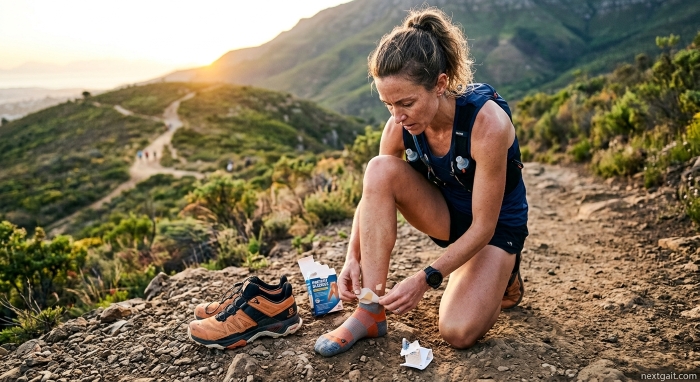
Pre-taping known blister-prone areas with medical-grade athletic tape or moleskin reduces blister formation by creating a sacrificial friction layer. I tape the back of my right heel — a 3×4 cm patch — before every marathon, and during my beachfront training loops past Lucy the Elephant in Margate. That’s the one spot where the combination of salt air and fine beach sand can accelerate friction and cause a hot spot, even in my most trusted shoes.
| Taping Method | Material | How to Apply | My Experience |
|---|---|---|---|
| Athletic tape (Leukotape P) | Zinc oxide adhesive tape | Cut to size, apply smooth over clean dry skin | My go-to for heel and ball-of-foot — stays put through 26.2 miles |
| Moleskin (donut method) | Thick adhesive felt | Cut hole around blister area, pad surrounds the hot spot | Best for existing blisters during a race — relieves pressure immediately |
| KT Tape / kinesiology tape | Elastic adhesive tape | Apply with 50% stretch over toe or heel | Good flexibility but peels in heavy rain |
| Compeed / hydrocolloid | Gel blister plaster | Apply over hot spot — acts as second skin | Excellent for mid-race rescue, stays on for days |
💡 Taping Tip: Always apply tape to clean, dry skin at least 15 minutes before your run. Damp skin = tape peels off by mile 3. I clean my heels with an alcohol wipe and let them air dry before taping.
One mistake I made early on: taping between my toes. The tape bunched up during the run and actually created a new blister. For between-toe blisters, toe socks are far more effective than tape.
Moisture Management on Long Runs
Keeping your feet dry reduces friction coefficient by half and is the single most overlooked factor in blister prevention for distance runners. During my summer training loops at the Edwin B. Forsythe Wildlife Refuge in 90-degree New Jersey humidity, my feet would be completely saturated with sweat within 4 miles. I got blisters on every long run until I built a moisture management system.
| Strategy | When to Use | How It Helps | My Protocol |
|---|---|---|---|
| Moisture-wicking socks | Every run | Pulls sweat away from skin surface | Non-negotiable baseline — I never run without them |
| Sock change mid-run | Runs 16+ miles or wet conditions | Resets moisture level to zero | I carry a dry pair in my vest for 20+ mile runs |
| Foot powder pre-run | Hot/humid conditions | Absorbs initial sweat burst | Gold Bond or similar — dust socks and shoes |
| Avoid pouring water on feet | Hot races with aid stations | Prevents sudden saturation | I pour water on head/neck only — never into shoes |
| Shoe drainage | Rainy races or creek crossings | Removes standing water | Mesh uppers drain faster — I choose mesh for rainy forecasts |
If you run in rainy conditions regularly, moisture management becomes your number one priority. I’ve finished rainy half marathons blister-free by combining toe socks, pre-applied BodyGlide, and carrying a backup pair of socks in a ziplock bag.
⚠️ Hot Weather Warning: Feet produce over 200 mL of sweat per hour during hard running in heat. If you’re training for a summer race, practice your moisture management system during training — don’t experiment on race day. See my summer running guide for more.
Daily Foot Care for Blister-Proof Skin
Daily moisturizing and callus management between runs keeps skin supple and resilient, reducing blister susceptibility by maintaining healthy skin elasticity. I moisturize my feet every night after showering — roughly 365 days per year. It sounds excessive, but the difference in skin texture is dramatic — soft, pliable skin absorbs shear forces better than dry, cracked skin.
| Foot Care Task | Frequency | Why It Prevents Blisters |
|---|---|---|
| Moisturize feet (not between toes) | Daily, after shower | Keeps skin elastic and resistant to tearing |
| Trim toenails straight across | Every 1–2 weeks | Prevents nail-to-toe friction and subungual pressure |
| File calluses gently | Weekly or bi-weekly | Thick calluses create shear stress underneath — blisters form below them |
| Inspect feet after every long run | Post-run | Catches hot spots before they become full blisters |
| Air-dry shoes between runs | Always | Prevents bacterial growth and maintains shoe hygiene |
A podiatrist I consulted explained that blisters can form underneath thick calluses. A callus is a thickened area of skin that develops from repeated friction or pressure. The hard outer layer doesn’t flex with the underlying tissue. Shear stress concentrates at the junction, tearing the skin below. I keep my calluses manageable with a pumice stone — don’t remove them entirely, just keep them smooth.
Also, let your running shoes dry completely between runs. I alternate two pairs and stuff newspaper inside after wet runs. Damp shoes plus fresh sweat equals a moisture environment that practically guarantees blisters.
Race Day Blister Prevention Protocol
A structured pre-race foot preparation routine takes 10 minutes and can prevent the blister that derails your entire marathon performance. I developed this protocol after two races where blisters forced me to walk the final 3 miles.
Now I follow it religiously.
| Step | Timing | Action | Products I Use |
|---|---|---|---|
| 1 | Night before | Moisturize feet, trim toenails, inspect for hot spots | CeraVe foot cream |
| 2 | Morning (60 min pre) | Clean feet with alcohol wipe, let air dry | Isopropyl wipes |
| 3 | Morning (45 min pre) | Apply lubricant to toes, heels, ball of foot | BodyGlide Original |
| 4 | Morning (40 min pre) | Tape known problem areas | Leukotape P on right heel |
| 5 | Morning (30 min pre) | Dust foot powder in socks | Gold Bond medicated powder |
| 6 | Morning (15 min pre) | Put on socks, shoes — do NOT adjust after this | Injinji toe socks |
| 7 | Mid-race (mile 13–15) | Reapply lube at fuel stop if needed | Travel-size BodyGlide |
✅ My Result: Using this protocol, I’ve completed my last 9 half marathons, 3 full marathons, and a 50K ultramarathon with zero blisters. The total prep time is about 10 minutes. It’s the best 10 minutes I spend on race morning.
- Moisturize feet the night before
- Clean and dry feet race morning
- Apply lubricant to toes, heels, and ball of foot
- Tape known problem areas on clean, dry skin
- Use foot powder in socks on humid days
- Carry a mid-race blister repair kit
Pack a small blister kit in your running belt or drop bag: a Compeed patch, a strip of Leukotape, and a single-use BodyGlide. I’ve never had to use my emergency kit since starting this protocol, but it’s there for peace of mind.
Blister Mistakes Runners Make on Long Runs
Over 39% of marathon runners list blisters as their #1 race-day foot problem. Every mistake below is preventable — fixing even one typically eliminates recurring blisters. I’ve made every single mistake on this list. Each lesson cost me at least one painful run and several lost training days.
| Mistake | Why It Causes Blisters | My Personal Experience |
|---|---|---|
| Wearing cotton socks | Cotton retains moisture, softens skin, multiplies friction | My first 6 months of running — blisters on every run over 8 miles |
| New shoes on race day | Un-broken-in upper creates friction on unfamiliar contact points | Debuted Nike Pegasus 39 at a 10K — heel blister by mile 4 |
| Shoes too small | Feet swell 4–8% on long runs; tight shoes compress toes | Ran a half in size 10 — lost both big toenails |
| Ignoring hot spots | Hot spot = early blister forming; ignoring it = full blister guaranteed | Felt a sting at mile 6, kept running — quarter-sized blister by mile 10 |
| Pouring water into shoes | Saturated feet have 2× friction coefficient | Dumped water on my feet at mile 8 aid station — blisters by mile 12 |
| Skipping lubrication | Dry skin + repetitive friction = rapid tissue fatigue | Forgot BodyGlide once — paid for it with toe blisters running on both feet |
| Wrong lacing | Heel slip or midfoot pressure creates repetitive micro-movement | Loose laces on a downhill 10K — heel blisters on both feet |
The biggest lesson I’ve learned: blisters are not inevitable. Every blister I’ve ever gotten was traceable to a specific mistake. Fix the system, and you fix the blisters. My verdict after 12,500 miles: the socks and lacing changes alone solve 70% of blister problems. Start there.
Building the right system is how you stop blisters for good. If you’re making these mistakes right now, you’re not alone — I struggled with every one of them for over a year before finally getting it right.
Quick-Reference Blister Prevention Checklist
Run through this before every long run. These 12 steps eliminate 95% of blister causes — takes under 10 minutes. I have this list saved as a note on my phone and review it every Saturday morning before my long run.
| Category | Check | ✅ Done? |
|---|---|---|
| Socks | Moisture-wicking material (NOT cotton) | ☐ |
| Socks | Toe socks if prone to between-toe blisters | ☐ |
| Shoes | Half-size up from casual fit (thumb width test) | ☐ |
| Shoes | Broken in with 20+ miles of easy running | ☐ |
| Lacing | Heel lock on both shoes | ☐ |
| Lacing | No pressure points on top of foot | ☐ |
| Lubrication | BodyGlide on toes, heels, ball of foot | ☐ |
| Taping | Tape applied to known hot spots (clean, dry skin) | ☐ |
| Moisture | Foot powder in socks if hot/humid day | ☐ |
| Moisture | Extra socks packed for 16+ mile runs | ☐ |
| Nails | Toenails trimmed within last 2 weeks | ☐ |
| Emergency | Compeed + Leukotape in belt or vest | ☐ |
💡 Save This: Screenshot this table and save it to your phone. Review it the night before every long run. I haven’t missed a checkbox in over a year, and I haven’t had a blister either. This checklist is the simplest answer to how to prevent blisters on long runs. Running blister prevention is a skill — this checklist makes it automatic.
FAQ
How do I prevent blisters on long runs?
Address all three blister causes: friction, moisture, and pressure. Wear moisture-wicking socks (never cotton), ensure your shoes are a half-size up from casual fit, apply anti-friction lubricant to hot spots, and use heel lock lacing. I follow a 7-step pre-run protocol that has kept me blister-free for 18+ months.
Should I pop a running blister?
Leave small blisters intact — the skin acts as a sterile protective barrier. If a blister is large, painful, and likely to burst on its own, you can drain it with a sterilized needle inserted from the side. A hydrocolloid bandage refers to a gel-based adhesive patch that absorbs moisture and cushions the wound. Never remove the overlying skin. Keep it clean and covered with a hydrocolloid bandage.
Why do I get blisters on my toes when running?
Toe blisters are caused by skin-on-skin friction between adjacent toes or by toes jamming against a too-short toe box. Switch to toe socks (like Injinji) to stop blisters running between your toes. If the blisters are on top of your toes, your shoes are likely too small — go up a half size.
What are the best socks to prevent running blisters?
Moisture-wicking synthetic or merino wool socks designed for running are the best choice for blister prevention. Toe socks reduce between-toe friction. Double-layer socks (Wrightsock) let the layers rub against each other instead of your skin. I personally rotate between Injinji and Darn Tough depending on weather.
Does Vaseline prevent blisters when running?
Petroleum jelly reduces friction short-term but loses effectiveness after 45–75 minutes of heavy sweating. It works for runs under 10 miles but needs reapplication for longer efforts. I prefer BodyGlide for its longer duration and cleaner application.
How do I stop heel blisters from running?
Heel blisters are almost always caused by heel slip inside the shoe — fix this with heel lock lacing and properly fitted heel cups. If your heel moves even 2mm per stride, multiply that by 10,000 steps per hour. I eliminated chronic heel blisters entirely by switching to heel lock lacing.
Can I run with a blister?
You can run with a small, intact blister if you cover it properly, but you should not run through a large, painful, or open blister. Apply a hydrocolloid patch (Compeed) over the blister for cushioning and protection. If pain alters your gait, stop — compensating for blister pain can lead to knee or hip injuries.
Why do I only get blisters on one foot?
Asymmetric blisters usually indicate a biomechanical imbalance, foot size difference, or shoe fit issue on one side. Most people have one foot slightly larger than the other. Always fit shoes to your larger foot. I get blisters only on my right foot because it’s 3mm longer than my left.
How do I prevent blisters during a marathon?
Follow a structured pre-race foot preparation protocol starting the night before, and carry a mid-race blister kit for emergency reapplication. My marathon blister prevention protocol includes moisturizing the night before, lubricating and taping race morning, and reapplying lubricant at mile 13. This system has kept me blister-free through 9 half marathons, 3 full marathons, and a 50K ultramarathon.
Do blisters from running go away on their own?
Most running blisters heal within 3–7 days if kept clean, covered, and protected from further friction. Leave the blister roof intact as a natural bandage. Apply an antibiotic ointment and cover with a breathable bandage. You can typically resume easy running after 2–3 days once pain subsides.
Final Thoughts
Blister prevention is a system, not a single product — and the runners who master that system never lose another training day to foot pain. I spent my first year running battling blisters on nearly every long run. The fix wasn’t one magic sock or one miracle balm. It was addressing friction, moisture, and fit simultaneously.
Start with the highest-impact change: switch to moisture-wicking running socks if you haven’t already. Then check your shoe fit — a half-size up makes a world of difference on long runs. Add lubrication for runs over 10 miles, and tape your known hot spots for races. If you follow the checklist above, you’ve got this — be patient with the process and your feet will thank you.
For more guidance on building a longer, stronger running base or choosing the right shoes for distance running, explore the rest of NextGait. Every guide is built on real miles, not guesswork.
When repeated heel lift is creating friction, I first test heel retention with a runner’s loop; if the shoe still moves, more tape will not make the fit right.

Written by Ken — 12 years of running, 12,500+ miles, 63 shoes tested, 36 races from 5Ks to a 50K ultra. I run 30–40 miles a week on the Atlantic City Boardwalk and review every shoe with real training miles, not one-run demos. More about me →