
The best hydration vest for trail running is the Salomon ADV Skin 12 for most long-run and race-day kits. It holds a serious load close to the torso, gives both hands access to the front storage, and leaves enough capacity for layers and required safety gear. Choose the ADV Skin 5 for shorter supported outings, or the Nathan Pinnacle Pro 12L if pocket access matters more than a stripped-down feel.
A vest is not a tiny backpack. The decision starts with the load you will actually carry, then the fit around that load. An empty vest can feel perfect in a store and become noisy, restrictive, or abrasive once two full flasks, a phone, food, and a shell start moving downhill.
My rule is simple: buy the smallest vest that holds your real kit without overstuffing, but leave enough room that you can reach essentials without unpacking the entire back. Capacity, fit, access, and bounce matter more than a long feature list.
Quick picks
| Use case | Pick | Why it earns the slot |
|---|---|---|
| Best overall | Salomon ADV Skin 12 | Secure high-capacity fit with excellent front access |
| Best 5 L | Salomon ADV Skin 5 | Lean option for supported runs and lighter mandatory kits |
| Best pocket access | Nathan Pinnacle Pro 12L | Generous storage arranged for on-the-move use |
How I judge a trail-running vest
I use a load-first six-point check. It is deliberately less glamorous than jogging with an empty sample, and much more useful. A vest passes only when it stays controlled with the exact fluid and gear the runner plans to carry.
- Load match: full flasks or reservoir, phone, calories, keys, shell, and event-mandated equipment all go in before the fit decision.
- Breathing room: the front closure must secure the load without restricting a deep inhale or pressing hard across the lower ribs.
- Vertical control: the bottles and rear load should not jump independently when running down steps or dropping off a curb.
- Side-to-side control: the rear compartment should not swing when the torso rotates or when the runner changes direction.
- Access: water, phone, and the next 30–45 minutes of fuel should be reachable without removing the vest.
- Friction check: inspect the neck, inner upper arms, lower ribs, and closure points after the run and again when the fabric is wet.
If you do not yet know the fluid load, calculate that separately with my trail-run water carrying guide. This page owns vest selection and fit; it does not prescribe individual hydration or sodium intake.
Capacity: choose by carried load, not distance alone
| Typical capacity | Best starting use | What changes the answer |
|---|---|---|
| 1–2 L | Short supported runs with frequent refill points | Heat, remoteness, mandatory kit, and personal fluid needs can make this too small |
| 4–6 L | Everyday trail runs, supported races, light layers | Bulky cold-weather clothing quickly consumes the spare room |
| 8–12 L | Long unsupported days, ultras, variable weather | Overpacking creates bounce; compression still matters |
Distance is only a rough proxy. A two-hour exposed summer run may demand more fluid than a cool four-hour loop with reliable refills. Before buying, lay out the full kit and compare it with the route plan in my trail-running safety checklist.
The 10 best hydration vests for trail running
1. Salomon ADV Skin 12 — Best Overall
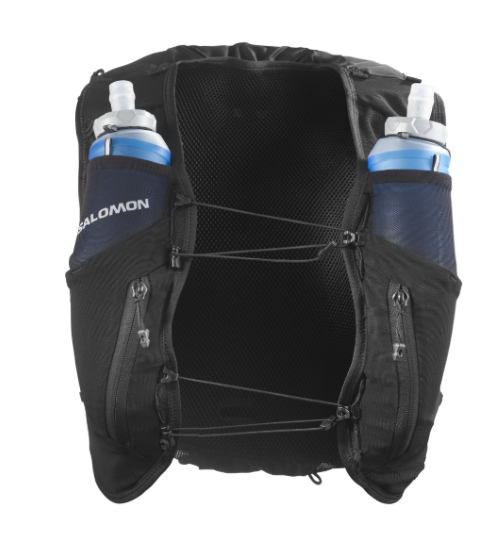
Verified configuration: 12 L; two 500 mL soft flasks included; compatible with a 2 L reservoir; manufacturer-listed weight about 9 oz.
The ADV Skin 12 is my default comparison point because it balances capacity with body-hugging control. The stretch pockets let the load settle toward the torso instead of hanging from a stiff outer shell. That matters late in a run, when every bottle bounce feels larger than it did at the trailhead.
Its front layout is the real advantage. Both included 500 mL flasks sit high enough to monitor and drink from, while smaller pockets can separate food, trash, and a phone. The rear accepts a 2 L reservoir, but I would not automatically combine a full reservoir and full front flasks. Start from your required fluid volume; unnecessary water is unnecessary moving weight.
Fit it with the flasks full. Tighten the chest cords only until the load stops, then inhale deeply and swing both arms. If the lower edge creeps upward or the bottles angle into the ribs, change size before adding more tension.
Best for: long trail runs, ultras, and runners who want front storage without giving up rear capacity. Skip it if: runners who carry only a phone and one flask, or anyone between sizes who cannot eliminate lower-rib movement.
2. Salomon ADV Skin 5 — Best 5 L Vest
Verified configuration: 5 L; two 500 mL soft flasks included; compatible with a 2 L reservoir; manufacturer-listed weight about 7 oz.
The ADV Skin 5 keeps the same close-to-body idea in a smaller package. It is the better Salomon when your packed kit fits without forcing a jacket into a hard ball or stacking dense items away from the spine.
Five liters is useful, not magical. Two full front flasks already establish much of the moving load. Add a phone, fuel, keys, and a light shell, and the vest can be close to its practical limit even though a product photo still looks spacious.
I prefer it when aid stations are predictable and the weather is stable. If you repeatedly lash gear outside because the rear is full, that is not efficient minimalism; it is evidence that you need more capacity.
Best for: supported races, everyday trail runs, and compact warm-weather kits. Skip it if: cold or remote outings where layers and emergency equipment exceed the remaining space.
3. Nathan Pinnacle Pro 12L — Best Pocket Access
Verified configuration: 12 L; 1.6 L bladder included; listed vest weight 250.8 g without the bladder.
Nathan earns this slot by treating storage as a working system rather than one large cavity. The Pinnacle Pro 12L gives long-distance runners more ways to separate frequently used items from emergency gear. That can prevent the classic aid-station mistake: opening the rear, moving everything, and forgetting what was put where.
More pockets only help when each has a job. I assign one front area to current food, another to wrappers, and keep the phone isolated from wet flasks. The back is for items I expect to use less often. This simple map matters when fatigue makes small decisions slow.
The included bladder suits runners who prefer a hose, but fill and burp it before judging bounce. Trapped air creates slosh that no sternum adjustment can solve.
Best for: long events where food, poles, layers, and small gear need distinct homes. Skip it if: minimal-load runners or anyone whose phone bounces in the intended front pocket.
4. Ultimate Direction Ultra Vest 12L — Best Structured 12 L Alternative
Verified configuration: 12 L; two 500 mL front flasks included; rear reservoir compatible.
The Ultra Vest 12L is the alternative I would try when Salomon’s torso shape feels wrong. It carries a comparable class of kit but uses a different pattern and adjustment feel. Brand loyalty cannot repair a poor match between the vest and your rib cage.
Load the densest items nearest the body. A shell can occupy the outer space; water and a battery should not. Use compression to remove empty volume after consuming water or food, because a vest that starts stable can loosen as the load shrinks.
Ultimate Direction’s current page lists two flasks and reservoir compatibility. I would verify the exact package at checkout because retailer bundles change, and I would not rely on inconsistent retailer weight conversions to choose between sizes.
Best for: ultras and long mountain days where organized capacity matters. Skip it if: runners who cannot get even pressure across both front adjustment zones.
5. Osprey Duro 6 — Best Secure Mid-Capacity Men’s Fit
Verified configuration: 6 L; two 500 mL soft flasks included; men’s-specific fit.
Six liters is a practical middle ground: enough room for a proper trail kit without inviting the just-in-case pile that fills a 12-liter vest. The Duro 6 suits runners who prefer a little more structure and an established harness feel.
The men’s-specific label describes the pattern, not who is allowed to wear it. Choose the shape that places the bottle bottoms clear of your ribs and keeps the rear panel flat. If the Dyna pattern fits better, that is the correct product regardless of marketing category.
Test the front pockets with your actual phone. A pocket can technically fit a phone yet still hold it too loosely for descending. The screen should not slap the flask or rotate toward the sternum.
Best for: daily trail runs and supported long runs needing more organization than a race belt. Skip it if: runners better served by Osprey’s women’s-specific Dyna shape or a shorter torso cut.
6. The North Face Sunriser Run Vest 8 — Best Balanced 8 L Capacity
Verified configuration: 8 L; two 500 mL soft flasks included; pocket for a 2 L reservoir; listed weight 260 g.
Eight liters solves a real sizing gap. It gives a shell and safety kit more breathing room than a 5–6 L design, yet makes it harder to carry a pantry of unnecessary gear. The Sunriser is therefore a sensible one-vest option for runners whose routes and seasons vary.
The reservoir pocket adds flexibility, but decide front-flask versus reservoir by access and load balance. Front flasks show remaining fluid and are quick to refill. A reservoir frees chest space and centralizes weight, but remaining volume is harder to judge.
When both systems are used, rehearse the hose routing and refilling sequence before race day. A vest is only efficient when you can operate it with tired hands.
Best for: runners who sit between compact race vests and full 12 L ultra storage. Skip it if: very short outings where the extra rear volume remains empty and uncompressed.
7. CamelBak Apex Pro Run Vest — Best Feature-Dense CamelBak Option
Evidence boundary: CamelBak’s current US running-vest collection confirms the Apex Pro remains in the line. Capacity, included hydration, and package contents must be checked on the exact size and seller listing; the collection page alone does not establish comparative fit.
I would put the Apex Pro on the try-on list for a runner who already likes CamelBak’s pocket logic and wants a feature-dense race vest. That is a fit hypothesis, not a universal verdict. Load it beside the leading alternative with the same phone, fluid, food, and shell.
Pay particular attention to hose or flask access, phone control, and whether the rear load stays centered after some fluid is consumed. Expel reservoir air before judging movement; trapped air creates slosh that tightening cannot fix.
A retailer may show a vest-only package, an included reservoir, or a different regional configuration. Confirm the exact bundle before comparing price. If you cannot try it loaded or the listing is ambiguous, choose the product with clearer fit and package information.
Best for: runners who already prefer CamelBak’s layout and want a current, feature-dense option. Skip it if: the exact bundle is unclear or a loaded side-by-side fit is not available.
8. Osprey Duro 1.5 — Best Minimal-Capacity Vest
Verified configuration: 1.5 L cargo capacity; two 500 mL soft flasks included; reservoir compatible; manufacturer-listed weight varies from 200 to 220 g by size; men’s-specific shape.
The Duro 1.5 is for runners who want water on the torso without carrying a full storage system. It can feel cleaner than a waist belt and keeps the hands free when the route is straightforward and support is close.
Its limit is the point. Once you add a substantial shell, a large phone, several hours of food, and safety equipment, the minimalist layout stops being tidy. Do not use creative stuffing to turn it into a 5 L vest.
Fit is more important than the gender label. Compare the Duro with Osprey’s Dyna shape if bottle position, chest closure, or torso length is wrong. Choose whichever loaded shape clears the ribs and controls the rear cargo.
Best for: short supported routes when a handheld bottle or belt is less comfortable. Skip it if: the route is remote, weather is variable, or mandatory equipment consumes the cargo space.
9. Salomon Active Skin 4 — Best Beginner-Friendly Compact Vest
Verified configuration: 4 L; two 500 mL soft flasks included; compatible with a 1.5 L reservoir; manufacturer-listed weight about 7 oz.
The Active Skin 4 is the compact Salomon I would show a new trail runner before assuming they need the premium ADV Skin construction. It carries the essentials in a familiar front-flask layout and keeps the decision manageable.
Its 1.5 L reservoir compatibility provides an option, not a recommendation to max out every water position. Fill what the route requires. Then use the remaining space for the items that keep a small problem from becoming a long walk out.
For a first vest, practice pocket use on easy ground. Learn which pocket opens with either hand and where wrappers go before adding technical terrain. My beginner trail-running guide covers the broader progression that this buying guide intentionally leaves out.
Best for: new trail runners building a simple, repeatable short-run kit. Skip it if: runners needing the stretch, pocket density, or capacity of the ADV Skin line.
10. Ultimate Direction Race Vest 6L — Best Lightweight Race Layout
Verified configuration: 6 L; current race-oriented vest with front hydration storage.
The Race Vest 6L is the leaner Ultimate Direction choice. It earns a separate place from the 12 L Ultra Vest because carrying less is not simply a smaller version of carrying more: pocket priorities, compression, and refill strategy all change.
Use the front for the next segment, not the entire day. Keep one or two foods accessible and refill that pocket from the rear at a planned stop. This prevents front storage from becoming a compressed jumble.
The rejection cue is simple: if mandatory gear only fits when every pocket is stretched tight, move up in capacity. A race vest should make transitions quicker, not turn every item into a packing puzzle.
Best for: supported racing and runners who value quick front access over maximum capacity. Skip it if: unsupported long days where six liters leaves no room for changing weather.
How to fit a hydration vest before committing
Wear the shirt and sports bra or base layer you normally run in. Put on the full vest, fill the hydration containers, and place the phone and food where they will actually ride. A fitting performed in a cotton T-shirt with empty bottles answers the wrong question.
- Loosen every adjustment, center the rear panel, then tension from the lower closure upward.
- Stop when the load is controlled. More tension is not more security if breathing becomes shallow.
- Jog, rotate the torso, raise both arms, and descend stairs. Movement faults often appear downhill first.
- Reach every critical pocket with each hand. Do not assume shoulder mobility will improve at mile 20.
- Wet the likely contact areas or test after sweating. Dry fabric can hide friction.
- Repeat the test with part of the water removed. The vest must remain stable as the load changes.
Wear the socks and shoes you already trust while testing a new carrying system. My anti-blister running sock guide and trail-shoe guide handle those separate gear decisions. For loose rock, sand, or burr-heavy routes, choose lower-leg protection separately with the trail-running gaiter guide instead of letting vest capacity drive the decision.
Pocket map: what belongs where
Put dense weight close to the spine or high on the chest. Put soft, light items farther out. Separate sharp or hard items from the skin. Food for the next section belongs in front; the emergency layer can stay in back.
A phone needs a pocket that controls all four edges, not merely one that closes. Keys need their clip. Wet layers need isolation from food and electronics. If rain is likely, use the packing order in my running-in-rain guide.
Fuel access should support the plan instead of dictating it. Set the plan with the trail-running fueling guide, then reserve a reachable pocket for the next interval.
Common buying mistakes
- Buying by race distance while ignoring weather, refills, pace, and mandatory kit.
- Choosing a smaller size because the empty vest looks sleek, then overtightening it around full bottles.
- Treating listed capacity as usable capacity for every body shape and every item shape.
- Assuming one unisex or gender-labeled pattern must fit because the volume is correct.
- Testing only on flat pavement; descending and lateral motion reveal different problems.
- Carrying duplicate just-in-case items without assigning each one to a credible route risk.
If most of your running is still on roads, decide whether a vest is necessary before optimizing it. The road-to-trail transition guide explains what actually changes, while the broader running gear guide helps keep the kit proportionate to the run.
FAQ
What is the best hydration vest for trail running?
The Salomon ADV Skin 12 is the best hydration vest for trail running for most runners carrying a long-run or race-day kit. It combines 12 L of capacity, two included 500 mL soft flasks, strong front access, and a close fit. The correct choice still depends on torso fit and the exact loaded kit.
Is a 5 L hydration vest big enough for a trail marathon?
A 5 L vest can be big enough for a supported trail marathon when refills are frequent, weather is stable, and the mandatory kit is compact. It can be too small for remote courses, bulky layers, or a large fluid requirement. Pack the complete course kit before deciding.
Should I use soft flasks or a hydration bladder?
Use soft flasks when you want visible fluid levels, quick refills, and front weight. Use a bladder when you prefer a hose and centralized rear weight. Both systems can work; remove bladder air to prevent slosh and test the full setup while running.
How tight should a running vest be?
A running vest should be tight enough that bottles and rear cargo do not move independently, but loose enough for an unrestricted deep breath. If eliminating bounce requires painful pressure, the size, shape, load placement, or capacity is wrong.
Can a hydration vest cause chafing?
Yes. Chafing can occur at the neck, inner arms, lower ribs, closures, and any seam that shifts against wet skin. Test the loaded vest in normal running clothes, inspect contact areas after the run, and solve movement or fit before relying on lubricant.
Do I need a hydration vest for every trail run?
No. A handheld bottle, waist belt, or no carried fluid may be enough for a short supported route, depending on conditions and individual needs. A vest becomes useful when it carries the required fluid and gear more securely and accessibly than a smaller system.
The bottom line
Start with the loaded kit, not the logo. For most long trail days, the Salomon ADV Skin 12 is the strongest all-around starting point. The ADV Skin 5 is cleaner for supported runs, while the Nathan Pinnacle Pro 12L prioritizes access and organization.
Whichever vest you choose, judge it full, wet, and moving. If it only becomes stable when you restrict breathing, or if critical gear disappears behind your shoulder, keep fitting. Those are product mismatches, not quirks you must learn to tolerate.

Written by Ken — 12 years of running, 12,500+ miles, 63 shoes tested, 36 races from 5Ks to a 50K ultra. I run 30–40 miles a week on the Atlantic City Boardwalk and review every shoe with real training miles, not one-run demos. More about me →